Decoding AI and Libraries

AI

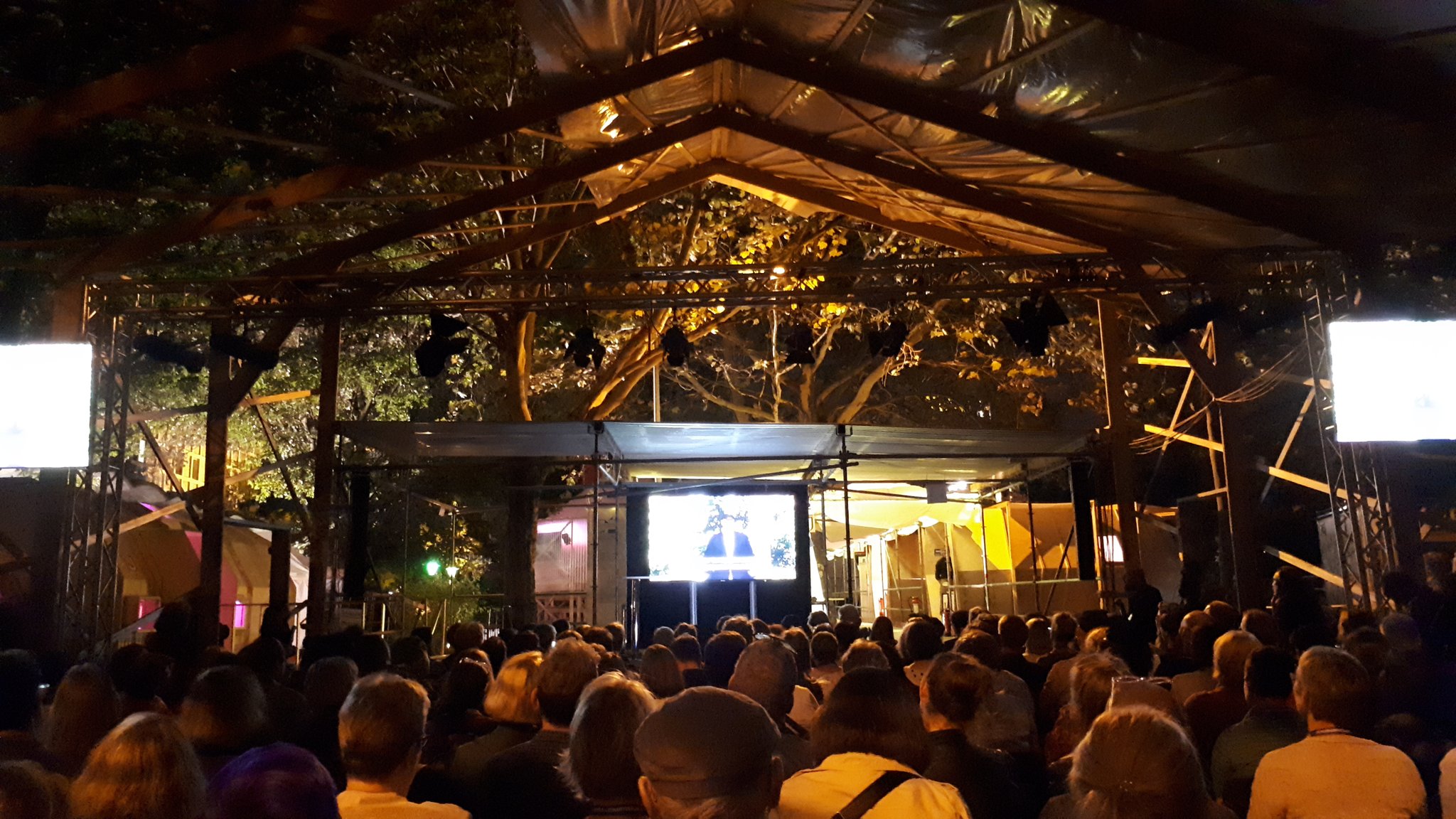
“Decoding AI and Libraries.” KB College: AI en de Bibliotheek – de computer leest alles. The Hague, Netherlands. (via video conference)

Speech Text: Read Speaker Script
Abstract: How can we think about AI and the role of libraries in AI development?

[This is the script I used for my talk. I’ve also taken the opportunity to add some foot notes and links.]

In the 90s I was working on a project called AskERIC – a service that would answer questions of educators and policy makers online. It was early days of the web, well before Google, Facebook, or Amazon. Yet even then we would regularly get questions about artificial intelligence; “i.e., Can’t machines answer these questions?” My boss’ answer was great – “We’ll use natural intelligence until artificial intelligence catches up.” 

A quarter century later, artificial intelligence has done some significant catching up. From search engines to conversational digital assistance to machine learning embedded in photo apps to identify faces and places, the progress of A.I. is breathtaking.

The last 10 years of progress is particularly impressive when you realize that A.I. has been a quest of computer scientists since before there was such a thing as computer science.

Today the larger conversations of A.I. tend to be either utopian

A.I. will improve medicine, reduce accidents, and decrease global energy use

or dystopian

It will destroy jobs, privacy, and freedom.

A.I. has also become a bit of a marketing term – soon, I fear we’ll be eating our cereals fortified with AI.

The hype and real progress have merged into a bit of a jumbled mess that overall can lead to a sort of awe and inaction.

Awe in that many of us in the library, and particularly public library community, may feel the details are over our head. A.I. is a game for Google. Inaction because the topic seems too big – what role is there for a library when these tools are being created by trillion-dollar industries?

True story, the same day my dean asked me about the possibility of creating a degree in data science and A.I., MIT announced a Billion Dollar plan to create an A.I. college[1]. I don’t think he appreciated me asking him if I would have a billion to work with as well. 

I’ve found these reactions – awe and inaction – are often a result of muddled vocabulary. So, for my contribution to today’s agenda, I’d like to briefly break the conversation down into more precise, and actionable concepts. My focus here will be in the contribution of public libraries, but I believe that the concepts are not only relevant to other public sector organizations but can only be truly implemented with partners of all types.

So rather than just think of A.I. as a big amorphous capability, I ask you to think about three interlocking layers: data, algorithms, and machine learning.

Ready access to masses of data has led to high-impact algorithms and increasingly to machine learning and black box “deep learning” systems. If we, librarians do not seek to have positive impacts at each of these levels – well, to be blunt – I would argue we are not doing our job and putting our communities in danger.

So, let’s begin with data.

The first thing that gets thrown into the A.I. bucket is the idea of data or big data. From data science to analytics there is a global uptick in generating and collecting data. With the advent of always connected digital network devices – read smart phones – in the pockets of global citizens, data has become a new type of raw resource.

And when I say global, I mean it. In 2010 the United Nations reported that there are far more people in the world that have access to a cell phone than to a toilet.

With this connectivity, most in society have simply accepted that one of the costs to being connected is sharing data. Sharing it with a carrier and sharing it with the company who wrote the phone’s software. Apple or Google probably know right now where you are, who you’re with, and if you use Siri or Google Assistant, they are primed to be listening to what you might be saying right now. No, I mean literally, right now.

The phone thing probably doesn’t surprise you. But what about the road you used to get here today? When governments build or repave a road, there is a good likelihood they are embedding sensors into it. Why? Well one reason is to save the environment and money in northern climates. How? In the winter rather than just lay down salt or chemicals on every mile of road, smart sensors can pinpoint where ice melt is needed, and reduce the application of costly chemicals.

Sensors are also used to determine the amount of traffic on the road, when to change signal lights, collect tolls, and check for wear and tear.

Add to this the data generated by cars on the road – digital radio, GPS, increasing autonomous driving – and the data begins to add up.

In fact, by one estimate in a few years each mile of highway in the U.S. will generate a gigabyte of data an hour. As there are 3.5 million miles of highways in the U.S., that would be 3.3 petabytes of data per hour, or 28 exabytes per year.

Just in case you are wondering, five exabytes is enough to hold all words ever spoken by humans from pre-history to about the year 1995. Now imagine over 5 times that a year, just on asphalt.

Now that may seem overwhelming, but at the data layer there is a lot of need, and space for libraries to participate. The questions to ask and develop answers to are familiar. Who has access to that data? How is that data stored and how do you find anything in that exabyte haystack? How do we make people aware of the data they may be sharing? How do we advocate for effective regulation to protect citizens?

I argue that public libraries should be steward of public data. Libraries have a VERY long history of data stewardship that includes respect for privacy and seeking equitable access to information. If we are going to allow our governments and our businesses to harvest data then we need to ensure our communities have a strong say in how that happens and trust in those that make the decisions. Right now, libraries have a stronger level of trust than Apple, Google, Facebook, and most elected governments[2].

The accumulation of data in and of itself is not particularly alarming. As libraries have shown over and over again having a bunch of stuff means nothing if you don’t have systems to find it and use it. This takes us to our second layer of concern in A.I.: algorithms.

Companies and governments alike are using massive computing power to sort through data, much of it identifiable to a single individual, and then these folks make some pretty astounding decisions. Decisions like which ad to show you, or what credit limit to set on your credit card, to what news you see, and even to what health care you receive. In our most liberal democracies software is used to influence elections, and who gets interviewed for jobs.

Charles Duhigg, author of “The Power of Habit[3],” tells the story of an angry father who storms into a department store to confront the store manager. It seems that the store had been sending his 16-year-old daughter a huge number of coupons for pregnancy related items: diapers, baby lotion and such. The father asks the manager if the store is trying to encourage the girl to get pregnant? The manager apologizes to the man and assures him the store will stop immediately. A few days later the manager calls the father, only to find that the daughter was indeed pregnant, and the store knew it before she told her father.

What’s remarkable is that the store knew about the pregnancy without the girl ever telling a soul. The store had determined her condition from looking at what products she was buying, activity on a store credit card, and in crunching through huge amounts of data. If we updated this story from a few years ago we could add her search history and online shopping habits, even her shopping at other physical stores. It is now common practice to use online tracking, WIFI connection history, and unique data identifiers to merge data across a person’s entire life and feed them into software algorithms that dictate the information and opportunities they are presented with.

In her book “Weapons of math destruction[4],” Cathy O’Neil documents story after story of data mining and algorithms that have massive effects in people’s lives, even when they show clear biases and faults. She describes investment algorithms that not only missed the coming financial crisis or 2008, but actually contributed to it. Models that increased student debt, prison time for minorities, and blackballed those with mental health challenges from jobs.

The recurring theme in her work is that these systems are normally put in place with the best of intentions.

And here we see the key issue in the use of software to crunch massive data to make decisions on commerce, health care, credit, even jail sentences. That issue lies in the assumptions that those who use the software make. Often very dubious, and downright dangerous assumptions. Assumptions such as algorithms are objective, and that data collection is somehow a neutral act. Or even, that everything can be represented in a quantitative way – including, by the way, culture[5]and the benefit a person makes to society[6]

What role is there for librarians, curators, and academics here? The answer on the surface is about the same as in our discussion of data. Education, awareness, a voice in regulation. However, we must be very aware of the nature of our voice. 

For too long librarians saw ourselves as neutral actors. We collected, described, and provided materials believing that these acts were either without bias, or that those biases were controlled.

In collecting we took it all…except for works that were self-published, or from sources we deemed of low quality. In cataloging we relied on literary warrant and the language of the community – often ignoring that we only saw the dominant voices of that community. Our services were for all – during our open hours for those who could travel to our buildings.

We as a profession are now waking up to the fact that we are a product of our cultures – good and bad. We understand that the choices we make in everything from collections to programs are just that – choices. Our choices may be guided by best practice, or even enforced by law, but ultimately, they are human choices in a material world where resource decisions must be made.

So as a library we are not asking to be neutral arbiters of data collection and uses. We are seeking to improve society through data and algorithms – that means we have a point of view. We have a definition of what improve means.

However, the biases we bring, or more precisely the principles, we bring to the Googles and Facebooks of the world is that a strong voice that advocates for transparency, privacy, the common good, and a need for a durable memory is important.

We recognize that bias exists even if we can’t always identify it, and so we require diversity and inclusive voices in our work. In this act we are not simply advocates, we are activists. A missionary corps of professionals equipping our communities to fight for their interests.

And this brings us to our last layer. The layer that most purists would say is true artificial intelligence development. The use of software techniques to enable machine learning, and especially the more specific deep learning.

That is, software that allows the creation of algorithms and procedures without human intervention. With techniques like neural nets, Bayesian predictors, Markov models, and deep adversarial networks software sorts through piles and piles of data seeking patterns and predictive power.

An example of machine learning systems in action would be feeding a system a number of prepared examples, say hundreds of MRI scans that are coded for signs of breast cancer. The software builds models over and over again until they can reproduce the results without the prepared examples. The trained system is then set upon vast piles of data using their new internally developed models.

With the wide availability of massive data, newer deep learning techniques do away with the coding, and go straight to iterative learning. Where machine learning used hundreds of coded examples, deep learning sets software free on millions and millions of examples with no coded examples – potentially improving the results and eliminating the labor-intensive teaching phase.

When this works well, it can be more accurate than humans doing the same tasks. Billions of operations per second finding pixel by pixel details humans could never see. And they can do it millions and billions of times never tiring, never getting distracted.

In these A.I. systems there are two issues that librarians need to respond to. The first is that these machine-generated algorithms are only as good as the data they are fed. MRIs are one thing, credit risks are quite another. Just as with our human generated algorithms, these systems are very sensitive to the data they work with.

For example, a maker of bathroom fixtures sold an AI-enhanced soap dispenser. The new dispenser reduced waste because it was extremely accurate at knowing if humans hands were put under the dispenser or say a suitcase at an airport. Extremely accurate, so long as the hands belonged to a white person. The system could not recognize darker skin tones[7]. Why? Was the machine racist? Well, not on its own. It turns out it had been trained on only images of Caucasian hands. 

We see example after example of machine learning systems that exhibit the worst of our unconscious biases. Chat bots that can be hijacked by racists through Twitter, job screening software that kicks out non-western names. Image classifiers labeling images of black people as gorillas[8].

However, bad data ruining a system is nothing new. If you’ve had about 10 seconds of work migrating integrated library systems, you know that all too well.

The real issue here is that the models developed through deep learning are impenetrable. That MRI example looking for breast cancer? The programmers can tell you if the system detected cancer, even the confidence the software has in its prediction. The programmer can’t tell you how it arrived at that decision. That’s a problem. All of those weapons of math destruction Cathy O’Neil described, can be audited. We can pick apart the results and look for biases and error. In deep learning, everything works until, well, an airplane crashes to the ground or an autonomous car goes off the road.

And so what are we to do? This is tricky. There can be no doubt that data analytics, algorithms taking advantage of massive data, and A.I. have provided librarians and society great advantages. Look no further than how Google has become one of a librarian’s greatest tools because it provides not only the ability to search through trillions of web pages in milliseconds, but often serves as a digital document delivery service undreamed of 25 years ago when I was working on AskERIC.

And yet, we still need that natural intelligence my boss, Mike Eisenberg, talked about.

Our communities, and our society, needs a voice to ensure the data being used is representative of all of a community, not just the dominant voice, or the most monetizable. Our communities need support, understanding, and organizing to ensure that the true societal costs of A.I. are evaluated, not simply the benefits.

That may sound like our job is the be the critic or even the luddite, holding back progress. But that’s not what we need. Librarians need to become well versed in these technologies, and participate in their development, not simply dismiss them or hamper them. We must not only demonstrate flaws where they exist but be ready to offer up solutions. Solutions grounded in our values and in the communities we serve.

We need to know the difference between facial identification systems, and facial identification systems that are used to track refugees. We need to know the difference between systems that filter through terabytes of data, and systems that create filter bubbles that reinforce prejudice and extremism.

And today is a great first step to honoring that responsibility.

Thank you, and I look forward to the conversations to come.


[1]https://www.technologyreview.com/f/612293/mit-has-just-announced-a-1-billion-plan-to-create-a-new-college-for-ai/

[2]https://www.youtube.com/watch?v=Tvt-lHZBUwU

[3]http://www.worldcat.org/oclc/881631924

[4]http://www.worldcat.org/oclc/1039545320

[5]his article certainly doesn’t claim that all of cultural heritage can be represented quantitatively. Rather I include the citation because it is a good introduction to the use of quantitative analysis of some cultural material and because it includes the very cool term Culturomics, “Culturomics is the application of high-throughput data collection and analysis to the study of human culture.” https://www.librarian.net/wp-content/uploads/science-googlelabs.pdf

[6]https://www.businessinsider.com/china-social-credit-system-punishments-and-rewards-explained-2018-4

[7]https://www.iflscience.com/technology/this-racist-soap-dispenser-reveals-why-diversity-in-tech-is-muchneeded/

[8]https://www.theguardian.com/technology/2015/jul/01/google-sorry-racist-auto-tag-photo-app

Librarianship in an Era of Big Data: The Vital Human Touch

“Librarianship in an Era of Big Data: The Vital Human Touch.” Conference of European National Librarians. Mo i Rana, Norway. (via video conference)

Speech Text: Read Speaker Script
Abstract: In a world of AI and Big Data the values, skills, and mission of librarians is increasingly vital. How do we prepare our professionals to guide and support communities across the EU? How do we ensure the smart citizen is at the center, and in control of the smart city? It is crucial that librarians advocate for issues of privacy and the common good in the midst of a growing market place that transforms users into products. How can librarians increase their value, work with technology giants to shape services, and in the end help our communities make smarter decisions and community members find meaning in their lives.

[This is the script I used for my talk. I’ve also taken the opportunity to add some foot notes and links.]

First, I must begin with an apology to Cecile and the organizers. For weeks they have been asking for slides. I have struggled to put into a concrete form what I want to say to such an important and, frankly, intimidating crowd. I have also spent a year wrestling with cancer and a bone marrow transplant. I don’t say this to get sympathy (maybe a little), but I have found that the experience has given me a new perspective on things that I am still trying to integrate. At once, I am grateful for just about everything, but tend to be less patient with things I feel need changed. And to be clear, as I look out at my home country and across the Atlantic, I see some need for change.

This crystalized for me when preparing for the talk and kept coming into the phrase “memory organizations[1].” If indeed Santayana was right that “Those who cannot remember the past are condemned to repeat it[2],” then what obligations does that place upon institutions who are charged as memory keepers of nations? I would argue that as stewards of cultural heritage, we are also stewards of society. I would also argue that we must stop serving communities, and start building them.

Our communities, our societies, our cultures are too important to sit on the sidelines and simply observe or collect their output. We must recognize, without the haze of nostalgia, that we are actors in this world and accept a responsibility to work directly with communities of all types to shape a better tomorrow. 

Now this could, and should, take many forms. Confronting growing economic disparities, alerting the world to the dangers of xenophobia mixed with nationalism, or confronting the realities of climate crisis. I could talk about the continuous marginalization of whole segments of the population because of race, or class, or sexual preference. Marginalization by society, and indeed, all too often by librarians and the libraries they manage.

Today, however, I would like to use just one societal issue to support a call for national libraries to directly build communities. This incredibly consequential issue often goes unnoticed. It is the dangerous aspects of an increased societal reliance on data-driven algorithms generated by artificial intelligence and machine learning methods. 

Before I begin, let me throw out a few caveats and clarifications. The use of data, when appropriately gathered and analyzed is incredibly powerful. Indeed, it underlies most of science. The rise of artificial intelligence, machine learning, and indeed Big Data has unquestionably brought massive benefits to many disciplines. The ability to search through trillions of pages in milliseconds, search across massive number of images, and the ability to automate complex processes have directly benefited librarians. The issue, as I see it, is when we believe that data gathering, analysis, and encoding into algorithms are somehow neutral acts without social costs[3].

In terms of clarifications; I will use the term community a lot. That is often seen as synonymous with towns, or citizens of a city. I use the term more broadly. When I say communities, I mean a group of people joined by some known variable and that share a means of allocating limited resources. A town is indeed a community sharing a common location, and a system of governance that allocates land, taxes, and other resources. A university is a community of scholars, staff, students, and administrators. A community can be a law firm, or a hospital, or a national library.

The other caveat is on the topic of national libraries. I have done some work with national libraries, but much of my relevant experience is working with state libraries here in the US. There is an old joke that once you know one state library, you know…one state library. I don’t pretend to be an expert on European National Libraries. However, from what I’ve seen, this is true of your institutions as well.

Some of you are active in networks with public and academic libraries. In some countries, there are multiple national library agencies. Some actively seek to support business communities[4], others focus on scholarly research. Bottom line – no one set of issues or models will reflect your great variety.

That said, I am reminded of the saying, “every idea is a good idea in libraries, just not in my library.” It is very easy to focus on what differentiates us now and believe that prevents collective action in the future. I hope I can successfully persuade you otherwise

So, with the caveats and clarifications out of the way, my purpose today is to recruit all of you to build a network of proactive librarians around European. I am calling on you to directly support, train, and empower librarians from those working in the most rural public library to those in the most prestigious university. What’s more is that I am asking you to engage in community building to shape a better future. Why? Well, let’s start with a story.

Charles Duhigg, author of “The Power of Habit[5],” tells the story of an angry father who storms into a department store to confront the store manager. It seems that the store had been sending his 16-year-old daughter a huge number of coupons for pregnancy related items: diapers, baby lotion and such. The father asks the manager if the store is trying to encourage the girl to get pregnant? The manager apologizes to the man and assures him the store will stop immediately. A few days later the manager calls the father, only to find that the daughter was indeed pregnant, and the store knew it before she told her father.

What’s remarkable is that the store knew about the pregnancy without the girl ever telling a soul. The store had determined her condition from looking at what products she was buying, activity on a store credit card, and in crunching through huge amounts of data. If we updated this story from a few years ago we could add her search history and online shopping, even her shopping at other physical stores. It is now common practice to use online tracking, wifi connection history, and unique data identifiers to merge data across a person’s entire life.

I am hardly telling you anything new here. Facebook is only the latest business to dominate the headlines with privacy breaches, and hidden data gathering. Most citizens of the EU and the US now live two lives: their own, and one created, often without their knowledge, from the digital debris created through our devices. Add to this increased requirements by governments and businesses alike to be online – to apply for a job, to vote, to receive health care, to listen to music – and we see a world that is moving faster than regulation, and faster than realization by those we seek to serve.

In Toronto, Sidewalk Labs, a subsidiary of Alphabet, Google’s parent company, is working with town planners to redevelop Toronto’s Eastern Waterfront. The story of transforming old industrial areas into gentrified multiuse spaces is nothing new. However, a large part of the controversy in this case comes in the plan to make the new neighborhood a data generator. The plan, according to The Intercept, “includes a centralized identity management system, through which ‘each resident accesses public services’ such as library cards and health care[6].” There has been a large debate over who owns and controls the data generated by that system, and who can profit from it.

Many librarians might look at these examples and claim a sort of ethical high ground. After all, as a profession, we explicitly value privacy. In the US we count it as a core value of the field, and yet we often undermine it. We tell our online patrons that we don’t track their work. And yet their internet provider can indeed track every click they make. Therefore, we are often misleading that patron and giving them a false sense of security. How many libraries set up TOR servers[7]or anonymizing VPN services[8]for our service populations? How often in our licensing of databases or other software do we explicitly forbid the aggregation of user data or the selling of that data? How often do we check on those terms?

Then there is the question of how all of this data is used.

In her book “Weapons of math destruction[9],” Cathy O’Neil documents story after story of data mining and algorithms that have massive effects in people’s lives, even when they show clear biases and faults. For example, an algorithm that led to outstanding teachers being fired. How? O’Neil writes about an outstanding teacher who had proven positive effect on under-performing students– raising their performance and grades significantly. As a reward, the teacher is given a year with honors classes filled with the brightest students in the school. However, the impact a teacher can have on honors students is not nearly as evident as those with students needing a lot of help. After all, top students receiving top marks can’t get better than, well, top marks. So the algorithm saw a teacher that was no longer effective in a classroom, and recommended the teacher be fired. Recommended by a piece of software using criteria that was hidden from teachers, and was assumed to be objective.

Algorithms are now used here in the states to determine health care cost and availability; access to credit for home ownership; suitability of a candidate for a job,; and even how long a person should be in jail.

Yuval Harari refers to this reliance on collectable data and algorithms as Dataism[10]. It is the result of computing power combined with machine learning and the wide availability of constantly connected devices like our phones. It is the belief that if you gather enough data on a person or situation, you can accurately represent that person or situation and predict an outcome.

It often also comes with some very dubious, and downright dangerous assumptions. Assumptions such as algorithms are objective, and that data collection is somehow a neutral act. Or even, that everything can be represented in a quantitative way – including, by the way, culture[11]. And before I make you wonder what any of this has to do with the work of libraries, or think I’m letting our profession off the hook, I have to say that librarians have suffered from some of the same dubious assumptions.

For too long librarians and library science educators saw ourselves as neutral actors. We collected, described, and provided materials believing that these acts were either without bias, or that those biases were controlled. In collecting we took it all…except for works that were self-published, or from sources we deemed predatory or of low quality. In cataloging we relied on literary warrant and the language of the community – often ignoring that we only saw the dominant narrative and voices. Our services were for all – from 9 to 5 with a researcher’s card who could travel.

We as a profession are now waking up to the fact that we are a product of our cultures – good and bad. We understand that the choices we make in everything from classification to exhibits are just that – choices. They may be guided by best practice, or enforced by law, but ultimately, they are human choices in a material world where resource decisions must be made. We can speed up digitization with newer machines, but we still have to pick a starting point. We can expand those we serve on the web, but still must acknowledge that there are people with no broadband or connectivity.

Now it would seem like this may turn to a call to redouble our efforts in neutrality. A call to wipe away the biases in ourselves so that we can confront the cost to society of skewed machine learning efforts. But it is not. In fact, we must embrace that libraries, and the librarians that build and manage them, are biased[12]. What’s more, it is only by seeing libraries as biased that we prove our value in the world of massive scale data.

First, we must realize that it is impossible to be neutral. Putting a book on a shelf or in a vault is a choice. Every day in archives and special collections we make professional determinations of how accessible an item is versus how protected it is. We can seek out many voices and yes, gather data, to make those decisions, but in the end, they are decisions with consequences. Pretending we are neutral doesn’t change the consequences, it only allows us to pretend they are not the result of our action.

Now, I keep calling them biases, but a better word would be principles. Principles are an explicit statement of belief. They should be transparent and, most importantly, able to be assessed. Are we following our principles? 

And make no mistake principles are not neutral. Seeking to serve all equitably takes effort and resources. Choosing to provide images for fee or free is a choice. Fighting censorship is a decision. If you don’t think so, try balancing it against issues of hate speech and threats to marginalized communities.

It is in our decisions and our transparency in making those decisions that we build trust with our communities. Our scholars, and entrepreneurs, and citizens don’t trust librarians because we are neutral, but because they agree with our principles and see them consistently applied. The days when libraries had the monopoly on access to large collections is well over. Yet libraries in most places the world are not only in use, but in growing use – public, academic, school, and national libraries alike.

Where library use (not necessarily support, but use) is growing it is because we are seen as accessible, equitable, and trusted. Yes, the collections we hold are valuable. The fact that we hold unique resources that either haven’t been, or can’t be digitized is important. But it is only important if those who seek out these resources trust us to be honest stewards of these resources.

It is our embrace of our humanity – our human touch in an increasingly automated system that underlies our value. This is not a luddite’s call against technology, AI, or machine learning. Rather it is a belief that human connection – community- is more important than ever when the face of government and business alike become web pages and bots under the banner of austerity or efficiency.

The future of libraries is ultimately not set by which technologies are developed or deployed. It is not in a value that was defined a century ago. It is in our very human ability to build trust with our communities. It is upon that trust that we build support. It is upon that trust that we build use. It is upon that trust that we find and confirm our necessity.

It is with that trust that we must reach out to the computer science community, the online industry, and the governments collecting data and deploying algorithms. We must advocate for a seat at the table and represent the voices of those without a seat. We must use the hard lessons we learned and are still learning in issues of diversity, equity, and inclusion to help guide these technologies. We must be trusted by our communities to speak truth to power and to give those communities power to speak for themselves. We must follow our principles in actively shaping, with our communities, the policies, regulations, and laws that talk about data. 

National libraries must play a large role in civic data stewardship. National libraries must not just safe guard the heritage of cultures, but the privacy and intellectual safety of citizens. You need to be a memory organization in the realization that effective memory is both about remembering, and, forgetting.

How do I resolve the paradox that I just advocated for a common role in institutions that I also acknowledge are so diverse? If indeed, you each represent unique institutions, does this preclude collective action? Of course not. Because in effect you are what all libraries must become. Every library- public, academic, school- should be shaped to the communities they serve. Then, as librarians, we become the connective tissue that seeks the best of all libraries and shape those innovations to local needs. Gone are the days when every library looked alike or supported some cannon of common services. Gone are the days when best practices extend to all libraries of a given size or type. Throw away the toolkits and instead build a toolbox[13].

We must prepare our librarians, regardless of title, or training, or location to be a missionary force proactively engaging in the well-being of our cultures and communities. We must build national peer networks that rapidly and effectively spread ideas and help librarians effectively shape them when they meet local needs. These networks discard best practice and industrial standardization for conversation, learning, and adaptation. We must connect the best thinkers together regardless of status or institutional boundaries.

How do important national institutions do this?

We must create platforms for continuous engagement of librarians where they can share, learn, teach, mentor and support each other. This may be built upon and with national and regional associations, but the focus is on individuals, not institutions.

We must create a system to formally recognize participants within and beyond this platform. Work with library science programs where they exist, but also extend the recognition beyond formal degrees to continuous learning.

We must recognize Lighthouse Libraries[14]that embody innovation and serve as inspirations, not blueprints, for other libraries.

We must proactively engage this network of change agents to transform libraries, associations, institutions, and ultimately communities globally. Members of our peer networks, our communities of practice, must encounter daily new ideas from across the globe.

Think of a library as movement, not a place or an institution[15]. It is a movement of people committed to improving society. Librarians, certainly. But also, scholars, politicians, entrepreneurs, programmers, and authors. Discard terms like users that reinforce the idea that our communities are consumers, and our only value is in the utility we provide to a demand. We have members and citizens; neighbors and scholars that all own and shape the library.

Most importantly, this will not happen in one hour of a conference. It will take more engagement, more experimentation, and more investment. That is why I support the PL2030[16]project. Building off of the Public Libraries 2020 project, it is a group of librarians from across the continent seeking to transform public libraries across Europe one librarian at a time. It advocates for libraries and builds connections between elected representatives and library innovators. But it needs help. 

PL2030 and the work of its members represent the need for a new vital link between the cultural heritage mission of National Libraries and public libraries. Libraries are transforming from access points, collections, and information providers into community hubs across Europe. From Manchester to Cologne to the amazing Dokk1 in Aarhus to Delft and Tilburg in the Netherlands and Pistoia and Perugia in Italy public libraries are the places communities come to learn, create and dream together. Here, by the work of innovative librarians, libraries have gone from quiet places of retreat to loud places of engagement. The true collection of a great public library is now the community itself. Blacksmiths and bakers host conversations. Librarians lend out books and musical instruments and recording studios. Rather than bringing the world to the community, these libraries have become loudspeakers broadcasting the community to the world. These public libraries have become the cradle of cultural creation.

As institutions charged in part with preserving and supporting the cultural heritage of a people, you need to preserve and support the work of these institutions. Not simply as a backup or for posterity, but as part of the living and breathing centers of community conversation. In a connected world – connected through technology certainly, but also in trade, in governance, and in preserving the earth itself – There is no more front-line service and library of last resort. We librarians are obligated to serve all, and in your nations now is a network of libraries eager for your partnership.

I thank you for your time, and I look forward to the conversation to come.


[1]Or “Memory Institutions” like the CENL Strategic plan https://www.cenl.org/wp-content/uploads/CENL-Strategy-2018-2022_final-1.pdf

[2]https://en.wikiquote.org/wiki/George_Santayana

[3]I love Chris Bourg’s take on the use of “societal cost” in discussing AI versus ethics.

[4]I’m a big fan of the British Library’s https://www.bl.uk/business-and-ip-centre

[5]http://www.worldcat.org/oclc/881631924

[6]https://theintercept.com/2018/11/13/google-quayside-toronto-smart-city/

[7]https://www.torproject.org/

[8]There are plenty of good articles explaining VPN. Here’s one that actually compares VPNs vs Tor: https://www.cloudwards.net/vpn-vs-proxy-vs-tor/

[9]http://www.worldcat.org/oclc/1039545320

[10]http://www.worldcat.org/oclc/1060991037

[11]This article certainly doesn’t claim that all of cultural heritage can be represented quantitatively. Rather I include the citation because it is a good introduction to the use of quantitative analysis of some cultural material and because it includes the very cool term Culturomics, “Culturomics is the application of high-throughput data collection and analysis to the study of human culture.” https://www.librarian.net/wp-content/uploads/science-googlelabs.pdf

[12]Here’s a good place to start on the discussion of libraries, librarians and neutrality:https://americanlibrariesmagazine.org/2018/06/01/are-libraries-neutral/In particular check out Emily Drabinski’s take.

[13]Pithy phrase, but in case it is not clear I mean stop sending out assembled ready to implement toolkits and focus on librarians gaining the tools to develop their own programs and/or create local application of programs customized to their communities.

[14]https://publiclibraries2030.eu/projects/lighthouse-libraries/

[15]Stole this idea from the amazing Marie Østergaard: https://podcasts.apple.com/us/podcast/princh-library-lounge-ep-3-building-global-networks/id1451326347?i=1000437039135

[16]https://publiclibraries2030.eu/

Expect More: From Change Agent to Advocate

“Expect More: From Change Agent to Advocate.” Congrès des professionnels et professionnelles de l’information. Montreal, Canada. (via video conference)

Speech Text: Read Speaker Script
Abstract: Society needs librarians who are non-neutral, proactive change agents.

With French Subtitles

[This is the script I used for my talk.]

Bonjour, je m’appelle David Lankes … and with that I will stop abusing your beautiful language.

Today I’m here to talk about being a change agent. I am also with you today to celebrate the translation of Expect More, a book I developed with libraries across North America to help change agents move our libraries and librarianship forward. I will refer to some ideas today that are explored in greater depth in Expect More and I hope you will become part of the conversations around the book and the field moving forward.

So what can I say about change agents? I could talk about things like the power of narratives. I could talk about the difference between innovation and invention. I could put up models of change, show the famous Everett Rogers Diffusion of Innovation distribution of early adopters to laggards. I could talk tactics like building a coalition of the willing and how to get the resistant on your side.

I could, and may, talk about those, but to begin I would like to tell you a joke, and then ask you a question. Here’s the joke:

An old professor of mine used to tell me Change is like Heaven…everyone thinks it’s a good idea, but no one wants to go first.

And this leads to my question. If you are preparing to be a change agent, what change are you preparing for? Many of folks who resist change are not stubborn or chronically cynical – they are unsure. We who seek change often have passion and enthusiasm, but sometimes lack the specifics needed for folks to evaluate and accept the change.

You see, that’s the problem with change. Many of us assume it is a positive thing. We talk about technological advances, not technological randomness – even though all of those advances at once can lead to extraordinary disruptions in our lives and communities. Yes, I can now transmit pictures of my lunch instantly to my friends, but at the same time thousands of people can now know where I am eating. I can email folks in the middle of the night with my great idea, but at the same time I can have a boss asking me how we are coming along on that great idea first thing the next morning.

And it is hardly just technology. Not even 5 year ago in the United States we were celebrating a Supreme Court decision that made gay marriage legal. Now we have a federal Department of Justice and Education saying that firing someone for being gay is legal, and trans students in schools have no protection.

Every year in South Carolina we graduate our new librarians in Rutledge Chapel. Rutledge was the first building that housed the South Carolina College – now the University of South Carolina. During the US Civil War, the building was used as a hospital for confederate soldiers. After the war it was opened up as a Normal School where professors of all colors trained freed slaves to be teachers.

However, once union troops withdrew and a new governor was elected he shut down the normal school and the college and re-opened it a year later for only white male students. It would be another 83 years until the university accepted another black student. I tell this story to our graduates to make the point that no change, not even a something so vital as a civil right is ever permanently won.

So, I assume that we are all here because we seek positive change in the library field. We want our communities, be they towns, or colleges, or businesses, to be well served.

But of course, that is not enough to enact change. What does well served mean?

I am here to tell you that we can no longer answer that in the way that we used to. We must expect more out of ourselves, our institutions, and our communities. And in order to do that – we must let go of long held notions of the field.

The first idea we must move past is that librarians and the institutions we build and maintain are neutral. If we talk about positive change, if we talk about smarter communities, if we talk about improved service – we have a point of view. Even if we talk about quality – we must acknowledge that high quality is different from low quality, and that takes a judge or arbiter.

We have seen the narratives of libraries change over the past decade. No longer do we talk about libraries as collections, or libraries as access points. Today we talk about libraries as transformational; we talk about a library’s mission as center of a community, or even necessary to promote democratic participation. We point to studies of libraries as investments returning so many dollars for every number of cents invested.

This line of reasoning is not neutral. Democratic participation is seen as good – community building as a proper use of dollars, and return on investment as a useful metric. Decisions all.

After we acknowledge that we are not neutral – that we seek to do good, to make positive change in communities – we must know there is a difference between providing a community with what it wants and providing them with what it needs.

Now, this has always been the case and it has reinforced some of the worst parts of society when seen in retrospect. Carnegie built libraries because, in his opinion, the workers could not choose what was best for them. We segregated libraries in the United States to prevent civil discord. We kept fiction out of public libraries because it was not seen as educational. Libraries are products of their society’s failures as much as their successes. Even so, libraries must quest to constantly do better.

So today, libraries do not seek to become Amazon because we believe in the importance of privacy and the need to serve all in a community – not just those who can afford it. We fight against racism and intolerance because diversity and learning are core to our mission, and the richest learning occurs in the presence of the most diverse views. These values of transparency, diversity, and learning don’t just stop at the library door – they must become part of our mission to instill them in the community itself. To be a true change agent is not to serve a member of the community, but to empower that person to advocate for their own needs and aspirations. And when some sector of our community is unable to advocate for themselves – then we must be their activist.

An activist not just for literacy, or library funding, but for equity of access to opportunities and throughout the community. Activists for new citizens. We must not simply be a service to a community, but a voice for the power of equity and leaning within that community. I wrote in Expect More “The difference between equal and equitable? The same (equal) versus fair (equitable). Equal service to a community almost always means ideal service to a sub-group, and variable usefulness to every other segment of that community. For example, letting anyone in a community borrow books is equality. Providing Braille books to the blind is equitable. Book borrowing, equal, home delivery to the housebound, equitable.”

When the Topeka public library in Kansas identified readiness for school as a priority of the community, they sought to increase literacy in 4 and 5 year olds. When they found that the lowest literacy rates were in one urban neighborhood – a neighborhood of poverty – they worked to build a bus route to bring people to the library for free. When the community couldn’t make it to the library because of the demands of multiple jobs, the librarians went in into the community. When there was more need than the librarians could provide they trained community volunteers to take up the slack.

When the Cuyahoga County library in Ohio identified the horrible reality of prisoners being released without resources – leading to a huge rate of re-incarceration, they acted. They went into the prisons to provide job skills and education. When they found no prison libraries, they worked with partners to bring in tablets loaded with materials and learning software. Then they set up appointments for released prisoners to meet with their local neighborhood librarians who helped them with housing and job skills. When they identified that ex-prisoners were losing benefits like food support because they couldn’t find stable housing, they worked with the county government to allow local library branches to be their official homes and to check in with their library card.

In the streets of Toronto, librarians drive Internet enabled cars into needy neighborhoods. In other Canadian towns libraries operate needle exchange programs, or host health fairs for the homeless.

All of these innovations were put in place because librarians came together to define positive change and what communities needed.

And so we come back to being a change agent. What change are you seeking? I tell you now that changing the mind of the 30 years of service reference librarian who still believes that the library should be books and wants to bring back the card catalog is impossible if you try to do it one change at a time. The first thing you need, we need as a field, is a vision of librarians changing all of society. Without this big vision, every change will be seen as incremental, a fad, and something to be waited out.

We need a vision where we can articulate why a makerspace belongs in some libraries, but not others. A consistent vision that talks about why some libraries need more stacks, and some need fewer. In essence we need a cohesive vision of the field that allows librarians to build libraries that are responsive to the unique needs of their unique community, but still part of a larger societal force.

For a long time, we thought that vision was based on information. Why did libraries go from physical owned materials, to physical and digital, owned and licensed resources? Because people needed information, or so the argument went. Books, databases, web pages, it was all part of an information buffet we laid out for our users. And indeed, they were no longer patrons, or even people, they were users. We defined people as what they sought to consume, and we worked very hard to make sure their consumption experience, their user experience, was efficient.

But something happened along this route that increasingly made librarians uncomfortable. Librarians found themselves compared to and aligned with an information industry that did not share our values. Suddenly user experiences in libraries were being compared to user experiences with Google and Facebook. At first as good examples, but librarians began to realize that the industry’s view of people as users, and interactions as experiences was being driven by a quest for data that could be monetized. Technology and data, once seen as neutral, now was being used to drive purchases, and was recreating old inequities. Ultimately making a sale and making meaning in a life are not the same thing, and librarians are increasingly rejecting this narrative. This is not the change we seek to bring to our communities.

It was never stated like this, but it emerged in how librarians started seeing their job and their relation to a community. Suddenly we were talking about third spaces, harking back to Oldenburg’s ground-breaking work. In Europe libraries become the new piazzas, the new town squares. We talked more about democratic participation, learning, and empowerment. Why did libraries move to embrace makerspaces? OK, part was because it was trendy, but the language around their adoption was not on technology and innovation, but empowerment. People, no matter their income or access to industry, could make things.

These ideas of meaning, of community, of providing a place apart from monetizing people as data does not fit into a vision of information. Instead we, as a community, needed to expect more of ourselves and our communities needed to expect more of us. There are thousands upon thousands of information sites available to our communities that are anxious to get our communities’ eyes and their data. We seek their minds and their ways of making meaning.

That is not information – that is knowledge. Our business, in the 4 thousand years of our discipline, has been to make communities smarter, and the lives of community members more meaningful. That starts in their heads – how they see the world. Humans are not just thinking organisms – we are learning organisms. That whole drive to learn and the unknown can be used to create novel and additive experiences to sell product, or it can be used to expand a person’s possibilities.

The librarians of Topeka, the citizens of Ohio, of Toronto, and Edmonton, and British Columbia are examples of how to build knowledge and empowerment. The literacy volunteers in the poor streets of Topeka were not informing users, they were educating people. The homeless of Washing State have come to see their library not as a point of distraction, but as a place to see new possibilities. They seek out the warmth of the building, but also the warmth of human compassion.

And to be clear, what works in Topeka, may not work in Montreal and what works in Plateau-Mont-Royal, may not work in the Borough of NDG. Knowledge is based on the uniqueness of our communities, not some standard that fits all. The days when libraries looked and worked the same across a province, or a country, or a globe are over. The true skill of a librarian is not implementing best practice from abroad, but in understanding their community. Does your college seek to be a top research university or a great teaching institution? Is your neighborhood affluent, or does it need you to serve as a social safety net?

That is a change we can believe in. That is a change that matters. That is a change that is durable.

So, you want to be a change agent? Fine, here’s what you need to know:

You are not neutral. You are less a change agent than an advocate for change. You have a point of view. Listen to your community, learn from your community, and know your professional and personal values. Then act upon them.

You are a facilitator. Yes, librarians can catalog and search, they can manage information, but the great change in our profession is adding the new skill of facilitation to librarians’ tool sets. Your community is your collection and you need to be able to engage that community and get them talking together. And then we must go even further. We must understand that a library is co-owned with the community. Not just overseen, or funded, but in every aspect of operation librarians must team with the community.

Communities are unique and librarians bridge to the global. For too long we viewed libraries as a product of the industrial age, and we sought efficiency and standardizing everything. You could walk into a library in Montréal or Toronto, or Hong Kong and they would have the same general structure. Now, we want community members to walk into a library and see themselves, and their uniqueness. It is the job of the librarians to find the best in Hong Kong and Seattle and adapt it to the local community.

It is time for us to expect more. We should expect more of ourselves. Librarians today don’t simply organize collections of offer programming. We engage communities and advocate for those communities. We empower community members to seek out their best selves and to find meaning. We no longer collect the work of story tellers, we are the story tellers weaving together the narrative of the community from the diverse threads of community members.

We must expect more from our communities. Instead of seeing those that we serve as passive users, we must see our community as a vast array of expertise and aspirations. We need to stop seeking to serve the community, and instead seek to engage that community – to partner with that community. To unleash the powers of that community upon the world.

We must expect more of society. We must work to make our communities more welcoming. We must seek to make our communities more knowledgeable. We must not only be a pace for reflection and investigation, but advocate for more reflection and discussion throughout all of our communities.

As I said in Expect More, a book I wrote and that the librarians of Quebec have now translated into French: Bad libraries build collections, good libraries build services, great libraries build communities. That’s not to say that libraries shouldn’t have good collections, or that libraries shouldn’t have services. Rather it is a call to librarians to focus on the community – the community is your true collection.

We must constantly look to reinvent and understand this profession anew. That’s what a living profession does. We’ve been around for 4 thousand years not because we haven’t changed, but because we have. And we’ve changed not simply because change is always good, but because our communities’ needs have changed. They’ve move from small towns and hamlets to the country side to farms to urban settings. We’ve moved from a slow pace of generational knowledge of monarchies and patriarchies to urban cities and new ideas of democracy. And all along librarians have been part of that transition. We have been advisors of kings, and now are advisors to everyone regardless of rank, regardless of wealth, regardless of race or creed or color. That’s why I am proud to be a librarian. That’s why we need to continue this conversation.

Thank you very much.

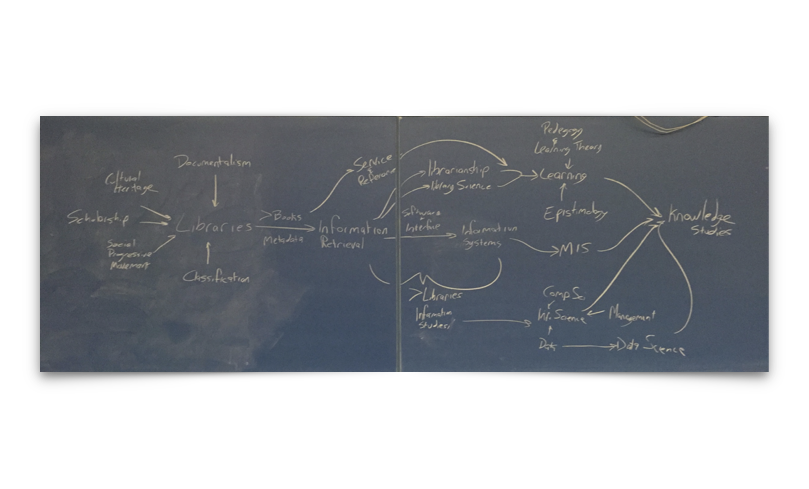
Information Science Versus Library Science in the in the Era of Technology

Chalk Board with Notes

“Information Science Versus Library Science in the In The Era Of Technology.” Keynote to the ICLIS International Conference 2018. Bandung, Indonesia. (via video conference)

Abstract: A brief discussion of how the field of library nd information science should be seen as a conversation, and the importance of talking about knowledge and social impact

South Carolina Library Association Remarks

Comments to the South Carolina Library Association. Greenville, SC. (via video conference)

Speech Text: Read Speaker Script
Abstract: South Carolina Libraries can help lead the world and help save it.

[This is the script I used for my talk.]

Today I am going to ask you to save the world. But that seems like a kind of heavy place to start, so instead I’d like to start with cancer.

There is a reason I’m not there in person, and a reason I have not been coming to visit your libraries recently. You see I am in confinement in Durham, North Carolina. I realize that sounds like I’m in prison – which might not surprise some of you – but confinement is actually a medical term.

In an attempt to rid me of cancer on August 24th my son donated nearly a liter of his bone marrow to replace my own. For the past 60 plus days I have been confined in Durham with daily visits to the Duke Medical Center for treatment. There were plenty of difficult days where just getting out of bed was a success. Daily transfusions of blood, 21 pills a day, and a white blood cell count of 0 can really take it out of you. But, I’m getting better. As I get better, I’m finding Netflix a bit less entertaining, and it turns out that I really hate jigsaw puzzles.

So my mind turns back to the world. It would be easy to find another series to binge or another book to read, but the world intrudes on any oasis after a time. I promise this talk won’t be a political venting. But it is impossible, no matter your politics, to see the stress and strife in the world. Issues of immigration, opioids, embolden racism, and a desire to pit us versus them seem to be a pandemic.

Between the nightly news and the overwhelming article sharing on Facebook – Facebook which seems to be in a race to get rid fraudulent voting information and leak our personal data-it seems we are entering into a new cold war with Russia, or China, or apparently a cold civil war. Twitter is toxic. The blue wave is coming or it will be overwhelmed by a red wave. Every commercial on Durham television after 6 is one politician bashing another. And don’t even get me started on the Pete Davidson/Ariana Grande split.

[Play Ghostbusters Video]

OK, that might be a bit over the top…but not so much for everyone. My point is that our communities are divided and under stress. Yuval Harari, the author of books like “Sapiens,” talks about this in his latest book “21 Lessons for the 21st Century.” He contends that the world organizes around huge narratives. Before World War II it had three to chose from: fascism, communism, and liberalism. By the way, liberalism as in liberty or more precisely liberal democracy – that’s us in this picture. After the War there were two: communism and liberalism. After the fall of the Berlin Wall, just one.

And now, too many of us see liberalism falling apart, or so Harari argues. When we are without some large guiding narrative, big questions become impossible to answer with consensus. Why do we fight a war? What is the purpose of our foreign policy? What is the American Dream today? And without a common narrative as a people we are regulated to us versus them, camps over countries, and personal gain over community advancement.

Now even if you don’t fully buy into Harari’s argument, there is a real danger of a people, community, and yes, domains, when there is no large scale narrative. I see this in an example from history. It is an example that looks at how without a working narrative a once well-respected profession was increasingly seen as obsolete – their tasks able to be learned by everyone not just professionals. The education of this discipline was stagnant, emphasizing theory and concepts over real application. It was a profession with service at its core and had existed for thousands of years.

The discipline I would like to talk about is medicine.

One of my favorite books of all time is John Barry’s “The Great Influenza.” Barry writes about the great swine flu of the early 1900’s. But it really tells the story of the rapid transformation of medicine from an art to a science.

Today we hold doctors in high esteem. We see the field as essential and specialized. Yet that was not always the case, particularly in the late 1800’s. Here are just a few excerpts from Barry’s book to paint a picture:

“Hence Oliver Wendell Holmes, the physician father of the Supreme Court justice, was not much overstating when he declared, ‘I firmly believe that if the whole materie medica, as now used, could be sunk to the bottom of the sea, it would be all the better for mankind-and all the worse for the fishes.’”

“…in 1835 Harvard’s Jacob Bigelow had argued in a major address that in ‘the unbiased opinion of most medical experts of sound judgement and long experience…the amount of death and disaster in the world would be less, if all disease were left to itself.’”

These opinions and ideas also had more direct consequences, that may sound a bit familiar. First in professional education:

“Charles Eliot…had become Harvard president in 1869. In his first report as president, he declared, ’The whole system of medical education in this country needs thorough reformation. The ignorance and general incompetency of the average graduate of the American medical schools, at the time when he receives the degree which turns him loose upon the community, is something horrible to contemplate.’”

Then in the reputation of the professionals themselves:

“As these ideas spread, as traditional physicians failed to demonstrate the ability to cure anyone, as democratic emotions and anti-elitism swept the nation with Andrew Jackson, American medicine became as wild and democratic as the frontier…Now several state legislatures did away with the licensing of physicians entirely. Why should there be any licensing requirements? Did physicians know anything? Could they heal anyone…As late as 1900, forty-one states licensed pharmacists, thirty-five licensed dentists, and only thirty-four licensed physicians. A typical medical journal article in 1858 asked, ‘To What Cause Are We to Attribute the Diminished Respectability of the Medical Profession in the Esteem of the American Public?’”

So what changed? Medicine developed a new narrative: one based on direct scientific observation. One that placed experimentation and sharing what works above grand theories developed centuries before. Doctors began listening to their patients. Doctors began using chemistry to develop first antiseptics, then anesthesia, then antibiotics, then a host of pharmaceuticals.

Note that the advances to medicine were not easy, straightforward, or strictly ethical. Core gynecological practice was developed with unwilling and anaesthetized slaves. The chemotherapies that were used to treat my cancer were developed from chemical weapons first used in World War I and later through exposing black service men to mustard gas…by the U.S. Army. But medicine is coming to face those ugly realities and developing codes of ethics that are inclusive and enforced.

And so we come to librarianship. A profession that too is adopting a new narrative. A new librarianship that is focused on our communities and the needs of people – not customers or users, but people. And in my confinement I begin to see stories globally of libraries that are not paralyzed by a growing nihilism and not building walls to be oasis and sanctuaries ignoring the concerns of the world around them. They, librarians, are building community hubs and services. They are taking the new narrative of librarianship – one based in both knowledge and action – and healing communities.

I read, for example about Glasgow Libraries in Scotland. They have teamed with a non-profit, Citizens Advice Bureau to directly address homelessness. They not only located experts in homelessness in the libraries, they train library staff to identify and approach the homeless as well. Then the librarians and Bureau staff work together to provide counselling, support and advice to people affected by homelessness.

I first became aware of this idea of public libraries serving as the functional local government from Gina Millsap, director of the Topeka Public Library. Kansas has become notorious for not having a functional state government as the legislature sits in opposition to the governor. This hasn’t stopped Gina and the librarians of Topeka from helping their citizens. They received an award when they set out to tackle illiteracy. They trained librarians in basic literacy instruction. When it became clear the neighborhoods in the greatest need of service was too far from the physical library, they worked with the city bus services to change bus routes. Then they sent librarians into those communities. When demand for the service became too great for the librarians the library trained hundreds of volunteers to work throughout the city.

The idea of libraries becoming direct civil service for their communities can also be seen in Cuyahoga, Ohio. The public librarians work in the local prisons. When it became clear the prisoners didn’t have enough education materials, the library teamed with Overdrive to fix tablets for the incarcerated. When a prisoner was set for release, the librarians set up appointments with their local branch librarian who would help them with housing and other social services. And speaking of prisoners, in Brazil the incarcerated can now read down their prison terms – 4 days for each book, 12 book a year.

I see a narrative of community support and learning in Narcan projects that prepare library staff to deal with opioid overdoses. I see programs, like the recently announced health insurance enrollment initiative of the Public Library Association. Bookmobiles converted to maker spaces to reach rural populations. Smart citizen initiatives across the European Union that demonstrates that there are no Smart Cities, without smart citizens trained in data-centered algorithms that can liberate and oppress.

I also see it very much in South Carolina. I see it in Richland with the difficult conversations where librarians facilitate community dialogs about race. I see it is Spartanburg where librarians are preserving history and making it accessible to their community members. I see it in Union with expanded facilities. I see it at the State Library where they are working with librarians of all types to accommodate people of differing abilities. I see it across South Carolina. Libraries that became areas of refuge and rebuilding in hurricanes and thousand year floods and respond to the horror of racial killing.

I also see it beyond public libraries. Academic libraries are teaming together to preserve the unique histories of communities. College libraries that have started to take on the reality that a number of college students become homeless trying to afford tuition.

Across the globe as politicians argue about immigration, librarians are going to resettlement camps to offer materials, and education, and hope. Librarians that turn citizen anxiety into voter registration drives.

In essence I believe that librarianship has passed from a sort of professional nihilism where we were going to be displaced by Google and Facebook and Wikipedia to a renewed mission to improve society through inspiring learning in our communities. And while this new librarianship, this new knowledge school of thought, is far from universal, it is growing and having a positive impact here in South Carolina, and in Germany, and in Uganda, and China, and Brazil.

This is far from the first time libraries have played a pivotal role in reshaping society. The librarians of ancient Alexandria were close advisors to the kings and queens in Egypt. Librarians kept ancient lessons available to the scholars of what is now Korea and China. Large libraries in the Muslim cities of the Iberian Peninsula helped advance architecture and mathematics and would eventually be the fuel for the Renaissance.

The libraries of Oxford and Cambridge fueled both the enlightenment and the industrial revolution. And those doctors who in the 1800’s found themselves on the verge of collapse? Today medical librarians are supporting the very team that is keeping me alive.

And so, I come back to my opening line. I am here to ask you to save the world. I am asking you to take the new narrative of knowledge and meaning that is displacing the old narratives of efficiency and access to information and spread it beyond your walls.

To be clear, this is a lot to ask.

Gone are the days when every library looked and acted alike. For while we are united by a single mission, how our communities make that vision a reality will be different. The mission of a librarian is to improve society by facilitating knowledge creation in his or her community. Or put more simply, our job is to make the lives of the people we serve, be they parents, lawyers, seniors, professors, gay, black, educated or not, to make their lives better and more meaningful through learning. Learning happens with the pages of a good novel, a comic book, hands on in a maker space, and talking online.

Your job as a librarian is not to offer everything – maker space, Narcan, prison liaison – but those services that best help your community reach its highest aspirations. Your job, as a librarian is to be an active part of a global network of librarians sharing ideas, experimenting, sharing results, and then working with community members to identify which ideas will work locally, and to adapt – not simply adopt – those ideas in your library.

You get collections that meet the needs and the demographics of your locality.

You get instruction and information literacy not based on some universal method – but that starts in local belief and ends in global awareness and is informed by rationalism.

You get engagement with industry and other local government based on the needs of the community, not simply opportunity.

You build smart cities with smart citizens who not only understand the potential benefits of technology and data, but the potential for oppression by algorithms.

You have my pledge that the University of South Carolina’s School of Library and Information Science stands ready to partner with you. We are teaming with libraries such as Charleston to develop new professional development opportunities for all staff. We have heard your worries about currency of curriculum and the fear of creating a sort of monoculture of thinking. We are currently remaking our curriculum as a knowledge school. And if you haven’t looked at our faculty in a while, take a look again. We have retained our best scholars and recruited a new array of amazing scholars over the past three years – nearly half the faculty is new.

I may be confined to Durham and home for this year, but the work of my school, and the work of building a global knowledge school of thought goes on. From Berlin, to Montreal, to Florence, to Mumbai to Columbia librarians are strengthening their communities. They are living up to the values of the field laid down over the past centuries: openness, diversity, learning, access, and engagement. Librarians in this state, this country, and across the world are putting these values into action within their buildings, and going out into the community. We are building strong local networks of schools, universities, businesses, non-profits, faith based organizations, and beyond to ensure every member of a community has the power to learn and find a place in that community. We librarians through SCLA, and ALA, and on Facebook, and in peer networks are connecting together a global corps of librarians and allies into the knowledge school of thinking.

Our communities are hurting, and bewildered, and dividing due to pressures of xenophobia, racism, economic disparity, and politicians who seek power above the greater good. We librarians, you and me, with our partners must tie them back together. We must model how even the most contentious debate can be conducted with respect. We must model how fake news is dispelled with knowledge, not picking a side. We must model that local government supported and overseen by the people, with the people, can be effective and powerful. We must model acting locally and globally for the common good.

Realize that in times of great uncertainty, people do not need a refuge walled off from the outside world, they need to feel empowered to effect that world. And that goes for you and you staff as well. Don’t tell me that your mayor or city council won’t let you, or the people don’t need it happen. In my very short time in South Carolina I have seen a library preserve signs and flags central to the civil rights movement. I have visited a library that was segregated well into the 1970’s now reach out across old mill towns to ensure that library service is available to all. I have seen a library team with a title I school and a Latino organization and the local city council to build a city-wide literacy effort. I have seen a county raise the salary of every worker in a library system to promote equitable labor practice. And I have seen an annual march on the capital by thousands of school children drawing attention to the importance of reading.

My fellow librarians now is your time. The need in our communities is great, but there is a resurgence of trust and funding in libraries. When you go home, bring your staff together and ask how can we convene the community and truly assess their aspirations and dreams. Connect together, not once a year, but every day. Build mentorship networks so no librarian ever feels isolated. Do this if you are in a big library or a small one. In a public library, or academic or special. Build the narratives of your community and celebrate it. Work with the county, and the hospital, and the pizza shop, and the tourist board.

My fellow librarians, let us now save the world.

Thank you.

New Librarianship: How Transformation is Necessary to Sustain Our Communities

“New Librarianship: How Transformation is Necessary to Sustain Our Communities.” 13th National Congress of Librarians Archivists and Documentalists. Portugal. (via video conference)

Speech Text: Read Speaker Script
Speech Text: Read Speaker Script in Portuguese
Abstract: Libraries have existed in one form or another for over 4,000 years. They have been around that long not because they didn’t change, but because they have constantly changed to meet the new and emerging needs of the communities they serve. Libraries and the librarians that build and maintain them, have adopted new services, technologies, and world views to meet their basic mission of improving society through creating smarter communities. Where once libraries were for elites, or a narrow portion of society, today they span society from birth to old age – from school to work.

This talk lays out a foundation of a new librarianship founded in knowledge and communities. It lays out a growing global knowledge school of thought that is transforming the core of librarianship not as a rejection of the past, but as the process every living vital profession goes through: serving the communities of today. Serving communities facing rising populism, political discord, massive human migration, wage disparities, technological disruption, and so much more. What the world needs now is not just a new services, but librarians prepared to serve all of society as advocates.

[This is the script I used for my talk.]

Ladies and gentlemen, I apologize that I could not join you in person. I am currently undergoing a bone marrow transplant to treat recurrent cancer. However, the organizers have been kind enough to allow me to address you through this video. I also apologize for reading from a script, but my hope is that by making the transcript available with the talk, it can overcome some of my limitations with languages.

Cancer is a horrible disease that has many effects on patients and those around them. For me, I fear, one of the side effects is a distinct loss of patience, and accompanying subtlety. So I apologize if my remarks are a bit blunt, and sometimes lack a nuanced edge. However, my main task for the congress, I believe, is to spark conversation.

So let me start with this: it is time for librarians to embrace transformational change in the way they work, and in the libraries they build. We need to make this change not to keep our jobs or preserve our place in our culture, we need to make this change because too many in the communities we serve are suffering and we are one of the last standing institutions that can help them.
Continue reading “New Librarianship: How Transformation is Necessary to Sustain Our Communities”

A Manifesto for Global Librarianship

“A Manifesto for Global Librarianship” Next Library Conference. Berlin, Germany. (via video conference)

Speech Text in English: Read Speaker Script
Speech Text in German: Read Speaker Script in German
Abstract: It is a time for thinking boldly about our profession, the role we play in society, and how we advance an agenda of smarter and more meaningful communities. Librarians must play a crucial role in their communities not as neutral providers of access to materials, but as advocates for the towns, universities, and communities we serve. We must connect to each other in new ways. We must fight for diversity, rationality, and against a society that increasingly preferences data and algorithms over people.
Audio:

A Manifesto for Global Librarianship

[This is the script I used for my talk.]

Greetings from the University of South Carolina. I apologize that I cannot be there in person, but know that cancer and a bone marrow transplant is about the only thing that could keep me.

Today, I would like to talk about the new reality that we, librarians, find ourselves in. A new reality created by trends in national and international politics that has seen the rise of nationalism in response to globalization. A new reality created by mass migrations brought on by war, poverty, violence, and climate change. A new reality brought on by longer lifespans, a greater concentration of wealth, technological advancement, and, finally, a new reality in understanding the role of learning and information in people’s lives.
Continue reading “A Manifesto for Global Librarianship”

Claiming Victory and Moving On

“Claiming Victory and Moving On” Rutgers University Beta Phi Mu Fall Speaker. New Brunswick, NJ.

Abstract: The rise of information as an idea and discipline since World War II has been driven by the belief that information underlies, and can change, just about every other discipline and industry. Library science scholars, and information scientists have sought to not only understand the nature of information, but to use technology to shape how work is done, and how we see the world. A worldview around information took shape and succeeded to the point that it is hard to identify an industry that is not, at least in part, an information industry. Manufacturing has become computer supported and built upon global logistical networks. Health has become a product of data mining from patient predicted outcomes, to pharmaceutical development, to personal monitoring devices. Journalism, law, even the arts has begun to adopt digital humanities. However, when every industry is an information industry – that is where industries and disciplines have adopted concepts from the information domain and made them their own – what is left in library and information science? What is core to our field that is not part of computer science, or communications, or psychology? Lankes will layout a new emerging world view based not on data, or information, but knowledge and meaning. He will talk about the necessity to shift the narrative in libraries and iSchools and propose an agenda focused on communities and the common good.
Slides: Slides in PDF
Audio:

Rutgers.mp4 from R. David Lankes on Vimeo.

The Future is About Knowledge Not Information

“The Future is About Knowledge Not Information” Bibliotheksmetamorphosen 2: Bibliothek 4.0. Winterthur, Switzerland.

Speech Text: Read Speaker Script
Abstract: The role of the public library as a place to collect and distribute information seems like an obvious success strategy for an increasingly connected and digital world. Yet there are many players doing this well beyond the capability of libraries. Could it be that the future is not about what libraries collect and distribute, but in how they help people learn from the torrent of information about them? This talk will look at how a shift away from containers and information to learning and knowledge not only situate public libraries for the future, but is the key to any successful industry of tomorrow.
Audio:

[This is an edited version of the script I used for my talk. However, it is not a word for word transcript. I believe portions were also recorded, and if so I will point to that when available.]
I was asked to prepare my remarks ahead of time for translation. This means I need to read them. Watching me read things is boring, so I have provided some more interesting pictures to look at.

For my talks in Europe I have been challenging myself to try and summarize my talks in a tweet – that appears to be the way of American diplomacy these days, so:

Values only practiced in buildings are like great stores – Limited to those who can afford it, find it, or those that already feel welcome

The organizers of this conference have asked us “what is the future of libraries in the digitized and networked society?”

Now you can just enjoy the pictures.

This is a dangerous question for a geek professor from the states. First it almost begs me to dream in flying cars and futuristic scenarios where we all interact with devices implanted in our brains. What’s worse, this talk is being presented in Switzerland, and from a United States perspective I feel somehow obliged to be amazingly scholarly and reserved.

However, the topic of librarianship truly calls out for something altogether different. It calls for a blunt conversation motivated by passion. Because that’s what libraries are ultimately about – helping communities harness their passion and dreams to create a better tomorrow. Isaac Asimov, the science fiction writer, once said

“You don’t need to predict the future. Just choose a future — a good future, a useful future — and make the kind of prediction that will alter human emotions and reactions in such a way that the future you predicted will be brought about. Better to make a good future than predict a bad one.”

This quote fits beautifully with my personal philosophy on the future, summed up nicely by Alan Kaye:

“The best way to predict the future is to invent it.”

What I will talk about today are my guiding principles to bring about Asimov’s “good future.” A future where the boundless passions and capabilities of our communities are unleashed by librarians. This is not about maker spaces, or flying cars, or augmented reality in the stacks. All those things may well be a part of tomorrow’s library. However, they should only be there if they match our ultimate mission.

The mission of librarians is to improve society through facilitating knowledge creation in our communities.

Or put more simply, we help communities make smarter decisions, and those decisions in turn lead to a better tomorrow.

How do librarians do this? Well, in many cases we build and maintain libraries. Libraries are community owned platforms, mandated by that community, and curated by library professionals on their behalf. Libraries may be buildings, and may be books, and may have maker spaces. None of these services define the future, however. The future is defined by the dreams of the community.

For us to ensure great libraries for our communities we must, as librarians, become a missionary force. A profession of facilitators that go deep into the uniqueness of our communities, enabling that diversity to foster all sorts of innovation.

In order for us to invent a good future, I believe there are three principles that must guide our work:

  1. The future of libraries is about knowledge, not data
  2. The future of libraries is not neutral
  3. The future of libraries is local and networked

I will takes these in turn.

Let me start out with the required provocative statement: I believe that information will kill librarianship.

I am not talking about the amount of information. Librarianship will not breathe it’s last because of too much information. We no longer talk about information overload. Why, because the mass of digital information that was once seen as overwhelming, has been tamed with the use of smart devices and the development of content filters, often self-imposed, that restrict our views to relevant information. We will come back to the consequences of that filtering in a bit.

I am also not talking about new forms of information access that will be the death of librarianship. This will not be a talk about how Google, or Apple, or Amazon will put libraries out of business. They haven’t and they won’t.

Will fake news and the fragmentation of the information landscape kill librarianship? Ah, now we are getting closer. But it is not fake news or fragmentation themselves that threaten the future of librarianship, rather it is understanding how librarians play a role in responding to these things.

What I am talking about is that information as an organizing philosophy and core concept of the field is the threat. Let me explain with a little history.

All living disciplines change and respond to changes in a larger culture or society. Farmers, for example, may have been around for millennia, but a farmer today no longer functions on the same core beliefs as his or her predecessor. Where once farmers waited for the seasons to dictate crop yields, today’s farmer is proactive picking crops based on forecasts, market forces, and the availability of fertilizers. Where once farmers slowly bred new varieties of plants, today’s farmer is intertwined into complex genetic experimentation and the design of new crops. Technology has transformed farming from a labor-intensive activity of small farms to an industrialized sector with global reach.

As it is with farming, so too is it with librarianship. Today’s librarians share a lot with those who had the title over the past 4 millennia. However, we have changed the underlying concepts that guide us. Libraries as closed stacks curated by scholars gave rise to a new populism that saw libraries as a way to educate the masses. Public libraries grew out of social movements aligned with a growth in democracy and an expansion of rights to the general population.

Much of how we think about libraries today was crafted at the end of the 19th century when industrialization thrust concepts of efficiency and standardization into our consciousness. This new industrialization was met with changes in technology, specifically the dramatic decrease in the costs of printing, to put in place concepts of book palaces. Growth in guilds and labor movements saw the professionalization of the librarian.

Most libraries of today have adopted a new perspective grounded in technology, data, and information. This is not surprising given the amazing advances in the field of information science, telecommunications, and computing. Librarians have come to see their jobs as informing users and serving customers. We all too often forget that our job is not to inform a customer, but to improve the life of a person.

We cannot, as an example, confuse access for impact. Giving an article to a person who cannot read, or providing internet access to someone who is computer illiterate is an act of access with no impact. No impact, other than making the person feel inadequate.

Informing as an act of access, or informing as a means of collecting and analyzing data does not meet our mission. Seeing people as users collapses complex human beings down to an information processor in relation to a system. They use a computer, they use a library. To meet our mission and to bring about our good future, we need to know more than what or how they use something, we must see people as makers of meaning.

In Madison County New York, the librarians of the Cazenovia Public Library sought to improve the life of families in poverty. They set up reading programs in a local food pantry. At the end of several weeks the director, Betsy Kennedy, gave each child a new book. As Betsy handed a book to one small girl, the girl began to cry. When asked what was the matter the girl said this book was the first new thing she had ever owned.

That program was not about giving information in book form to the girl. The program was not about informing the girl. It was about improving the girl’s life. They had done so not only in their outreach, but in showing the girl she was worthy of a new book. She was worthy.

They later expanded the program to provide education and training the parents who came to the food shelter. They then expanded the program throughout the county in food pantries, libraries, and churches. These families were not users, nor customers, but neighbors. The librarians sought to not only inform their neighbors but to demonstrate that these people had worth, and facilitate these families in making meaning of their lives. The library was not a source for access, but a platform to create a future.

In Cuyahoga County Ohio, the public library runs many branch libraries. One of these branches is in a prison. Behind bars librarians provide training and materials. When an inmate is due to be released the librarians set up appointments with a local branch librarian. There the former prisoner can not only check out books, but enroll in job training. It is not the goal of a librarian to provide prisoners with information, it is to provide them with hope and a sense of personal worth. In doing so they seek to decrease recidivism rate, and future incarceration. They are helping that person, and they are helping the community as a whole, and they are helping themselves because the librarians are demonstrating their value and improving a community of which they are a part.

A focus on library as information provider is both an abdication of the role a library plays in our communities and puts us in competition with tool makers. A focus on books circulated, pages transmitted, people in a building are easy counts that miss the larger goal. In our good future, we must traffic in the improvement of lives, not the caretaking of information.

Google, Amazon, Apple, all of these are excellent tools to help us do our jobs. Just as books, buildings, computers, and 3d printers are tools to help us do our job. The goal is not the tools. We are not caretakers of tools, but advocates of our communities. All too often we have adopted an information perspective that merges data with knowledge, books for knowing, and bits for thoughts.

We see this in how some approach the question of information literacy. The problem of fake news and the role of foreign powers in using social media to influence elections is important. However, in our discussion of solutions we give too much power to information and data, and indeed to those who seek to manipulate us. The real problem with fake news is not intentional misrepresentation of news for political or financial gain. That has been with us forever. The real problem is a fracturing of commonly held beliefs and values within our communities.

People are more likely to believe and seek out conspiracy theories and false narratives in the absence of a community held narrative. Nationalism and xenophobia grow when we allow communities to mistrust each other. The solution to rising extremism is not better identification of dates and authors, but bringing diverse community members together to learn and respect one another. In essence, information literacy needs to be less about sources and more about conversation. Less about data and more about trust. Knowledge is information with a social mission and action.

This leads me into my second principle: The future of libraries is not neutral.

And here is where we face the obvious. If you are going to talk about a good future, you have to define what good means. In doing so, you cannot be neutral. If you think a good future is one that uses tax dollars to support libraries? You have a point of view. If you feel more people should read? That too is a bias. Further, do you see the importance of literacy as a function of democratic participation and/or workforce readiness? Those are points of view, and not neutral.

During the recent refugee crisis in the European Union we saw librarians taking in displaced peoples. We saw librarians go out to refugee camps and offer services. When they did so, they were not neutral. Elements of EU communities very much objected as part of the rise of nationalism and xenophobia. These same forces of xenophobia and nationalism are seen in the US where libraries provide library cards to undocumented peoples, and where public libraries provide food support to any comer much to the irritation of nationalists. The librarians are acting out of a bias towards inclusion and service, and that will only become more uncomfortable in our increasingly polarized communities.

I want to be clear, I am talking about libraries being principled, not ideological. For me the good future for libraries involves an organization staffed by principled professionals working in the best interest of their communities and fighting for a vibrant public sphere. Librarians must counter discrimination in all its form. Discrimination based-upon race, gender, sexual preference, and religion (among others) stands in direct conflict with the underlying values of librarianship. We seek to provide physical and intellectual safety to our communities. We seek to become safe places to explore dangerous ideas. We believe that different views must coexist in an atmosphere of mutual respect.

There are those who feel that libraries must be passive, public servants bowing to the will of the people. This is not the role of a professional, nor should it be the role of any member of the community. Librarians should seek to shape the narratives and values of the community just as we expect all sectors of society to do so.

There are those that feel libraries, particularly public libraries, are incapable of shaping communities. That libraries are agents of a larger system of neo-liberal corporate and political interests and thus unable to bring about change. I say this is the worst form of pessimism, and ignores the impact of libraries and librarians throughout history.

In the 1800’s in the US there were many articles and editorials attacking libraries as including seditions and salacious materials. The thing they were worried about? The media that would have young girls thinking beyond their station, and farm boys beyond the farm? The materials that appealed to fallen ladies and denizens of the night? The literary novel.

Today we take for granted that fiction and literary novels are part of library collections. We take it as an assumption that literacy and story-telling are what librarians do. Yet that only happened because librarians chose to stock the materials, and defend them. How we view the public library of today is not an accident, or solely a result of outside influence. Librarians and library staff have continuously honed a vision of librarianship around diversity and narratives for centuries.

And we must continue to do so. We must recognize that while libraries should be a safe place to explore dangerous ideas, they will only be so if we make it happen. Our ideals trapped in a building are as useful as food stocked in a store. If we limit our services to those who can afford it, find it, or those that already feel welcome, we will leave parts of our communities to starve.

In Topeka Kansas, the librarians partnered with schools, and charities to ensure all children were ready for school. As they planned events, tutoring, and programs it became apparent that the neediest members of the community would never benefit from such efforts in the library. These communities were trapped in economic isolation with little to no transpiration to get to the library (or jobs or services). These primarily minority communities were trapped in neighborhoods with little nutritious foods, few jobs, and little ability to escape.

So the librarians approached busing companies, and sought to find means of transportation. When that wasn’t enough they trained their librarians and community volunteers in literacy and sent them out of the building and into the streets of need.

In my own state of South Carolina and in the northern reaches of the Netherlands, librarians have equipped busses with maker spaces, materials, and experts to go to the people in need. They do this not out of a sense of neutrality, but out of a sense of idealism and activism.

The problems our communities face are too important and too entrenched to solve as neutral servants within a building. The needs and suffering of our communities require empathy and passion. What we are bringing to these people is not information or materials, but hope and self-worth. Librarianship is a promise to communities that they are worthy, that learning is a key to happiness, and that all people, no matter their color, or wealth, or politics deserve support.

And this then brings me to my third principle on how we do this: The future of libraries is local and networked.

Switzerland is not the United States of America. It is not Kenya, or Tokyo. The cities and villages of this country are unique. A key part of the passionate caring good future of libraries is in embracing this uniqueness. Some communities aspire to growth, others to economic well-being, still others to a rural lifestyle, or quality of life issues. For some education is a barrier, for others an asset. Our libraries must look and act like these communities.

I do a fair amount of international traveling. I am often fortunate enough to spend some time sightseeing and being in these communities. Some folks in this situation seek out museums, or monuments. I seek out grocery stores. I realize this is odd. Why grocery stores, aside from a clear problem with buying sweets? Because I have found no faster way to discover the similarities and differences in culture.

For example, just about every country’s stores will have bottled water, bread, and cereal. However, when I walked into a grocery store in Beijing, I found a seafood section that to my American eyes looked more like an aquarium. Live shrimp flipping out of bowls, blowfish, and a huge number of living fish I couldn’t begin to identify. In the UK, the milk is warm. In Sweden, most of the candy comes in the form of gummies. I find it fascinating.

Then I walk into the libraries. Big reference desks, stacks of books, some reading space. Certainly, the architecture varies, from renaissance rooms in Italy, to shining steel and glass atriums in Scandinavia. However, how different are they really?

The future library needs to look like its community. Not only in the architecture, but the collection (if there is one) and the services it offers. In the tribal lands of Kenya, libraries keep a collection of tribal robes. These robes are not for display, but use. In the river country of Wisconsin, librarians loan out fishing rods. In Fayetteville, NY an educated community can check out electronics and telescopes. Their collections are shaped by the learning of the communities.

We must also take this localization a step further. We must realize that the community is the collection. In Pistoia, Italy the San Giorgio Library has become the new piazza, or central square for the city. Each week they host dozens of programs where members of the community share what they know. Social workers and iron smiths demonstrate their expertise. Citizens gather for movies and talk about the daily occurrences in a café. In Tilburg, the new library is being built in an old train repair factory – helping to transform the historic industry of the city’s past into an economic engine for the future. The library sits beside, and sometimes within, incubator space for new companies.

Our libraries and their offerings must be as diverse and unique as the communities we serve. We must think very locally. What is considered good, and knowledge, and aspirations must be tied to the ground, not imposed from an international discipline.

In order for this to succeed, however, no library is an island. These very local libraries must be networked. Here I am not talking just about data, and fiber, and the internet. I mean you. It is your job as librarians to seek out the best idea from other libraries, industries, other cultures, and other domains, and contextualize them for your community. Not every library needs a maker space. Those that do may consist of 3d printers, or sewing machines, or recoding studies. It your job to adapt not simply adopt, good ideas for the good of your people.

There is an old joke in technology, that IT never says no, they just how three letter acronyms at you until you stop asking. I am convinced there is a library equivalent. Librarians never say something is a bad idea, just that it is a good idea for someone else. Too often this leads us to compartmentalize the field. I’m not a librarian, I’m a public librarian. I’m not a public librarian, I’m a public services librarian, and so on and so on.

We must realize that we are all librarians and we can learn from each other. I should take a moment to say I have a rather broad definition of librarian. If you were hit by a bus and the library can’t function…you’re a librarian.

So there are my three principles for inventing our “good future” for libraries. Focus on knowledge and impact, not information and data. Be an agent for positive change, and don’t hide behind illusions of neutrality. And build locally while connecting globally.

How does this look in your library, in your community? That’s very much a conversation you have with your public. Will this future involve technology? Yes. Do librarians need to be well versed in internet tools and even data mining? Yes…not all, but some.

I end my remarks with an invitation. An invitation to join a new school of thought in the field, what many of us are calling the Knowledge School. This is not an academic unit in a college, or a place. It is not an association. Rather it is a movement. It is a movement around progressive librarians committed to improving society. It is a network of experts, scholars, practitioners, and allies. The Knowledge School seeks to link together change agents in libraries, government, and industry. It seeks to lay out an agenda to ensure librarianship remains relevant, and our communities vibrant.

The Knowledge School exists at the University of South Carolina and the Frysk Lab of the Netherlands. It is in the work of the Fayetteville Free Library and Chattanooga Public Library. The Knowledge School is in the streets of Toronto where librarians park Wi-Fi enables cars to provide service to neighborhoods. It is in the mountains of Switzerland and the marshes of Thailand. The school consists of librarians in large and small libraries, urban and rural.

The Knowledge School prepares librarians, information specialist, number crunchers, business leaders, and community educators. We send them to libraries and schools, fortune 500s, think tanks, & startups. We put information into action. We change the world. We are a movement. We are the knowledge school.

Thank you.

The Library: The System of Systems

“The Library: The System of Systems” Community and Knowledge: Participatory Strategies to Promote Change. Perugia, Italy.

Slides: Slides in PDF
Speech Text: Read Speaker Script
Audio:

[This is an edited version of the script I used for my talk. However, it is not a word for word transcript.]
I do not normally speak from a script, but these are important topics and it is worth taking care to ensure language issues do not get in the way of a vital conversation. It also useful for jetlag.

I have taken to summing up my presentations in a tweet in case a certain US President is listening in. Here is my tweet for this one:

Librarians transform communities by weaving together the brilliance of its people. The result is called a library.

Let me begin with thanking the conference organizers for having me. I have fallen in love with Italy. This is my first visit to Umbria, and any chance I get to explore more of this wonderful country is most appreciated.

Part of the reason I love my time in Italy is well represented in today’s agenda. Culture, health, innovation, economic development – you see these forces in work in the streets of Italy’s cities, both new and ancient. Within minutes I can walk from 15th century reading rooms to water-cooled data centers. On trains, I watch the country side flash by olive groves and super-car manufacturing. It is a nation in constant evolution, where history and future are always in conversation.

As a visitor, a tourist really, I can’t begin to fully appreciate the daily fabric of your lives, but I believe I can offer something unique – a fresh perspective. New eyes on your communities and a background in how other cultures and countries have sought to use local resources to advance an agenda of growth and smarter communities.

Today I want to talk about libraries, and more importantly, librarians. I want to talk about libraries in a new way – not as institutions, or collections, but as a platform for weaving communities together, and proactively working to define and then fulfill community aspirations.

I have seen libraries serve as engines of economic development – fostering communities of entrepreneurs and small business. I have seen libraries embrace the neediest members of a community and act as a social safety net integrating the refugee, the homeless, and the poor back into a larger, kinder community. I have seen libraries serve as universities of the people, increasingly literacy rates, improving workforce development for industry, and supporting students online. I have seen libraries crack open treasure troves of cultural heritage and history to a new generation; inspiring the arts and science alike. I have seen libraries step forward and become the only truly functional local government amongst partisan bickering.

All of these libraries had something in common. First is a dedicated core of professionals that proactively engaged their communities. The second is a proactive agenda, where they worked across all sectors of a community to develop a common narrative, and a common mission for the community. All of these libraries that made a difference shared an underlying philosophy based on knowledge and people making meaning in their lives, not information, or books, or a focus on the tools of learning. Lastly, all see the library not as a place, or a collection, but as a platform – a system of systems – that knitted together community expertise. In essence, these librarians understand that the true collection of a library is the community served, not the books and tools that were used in that service.

Let me take these in turn. I begin with that dedicated core of professionals: librarians.

Too many people define a librarian as a person who works in a library. I do not. I see libraries as the things created and maintained by librarians. Now I have a very broad definition of a librarian. Librarians are defined by their mission, their methods, and their values.

The mission of librarians is to improve society through facilitating knowledge creation in their communities. It is not to house and hoard books – though they may build collections in the realization of their mission. It is not to catalog – though they certainly have skills in classification and metadata. No, the first important part of defining a library is to realize that it is not what a librarian does that defines them. Rather it is WHY they do.

What you need in your communities, your villages, your towns, your cities, is not a worker, but a missionary – literally, a person on a mission. A missionary that is focused on helping their communities make smarter decision through knowledge creation. Let me simplify that – through learning. The mission of a librarian is to help communities make smarter decisions.

And what do these librarian missionaries do? How do they facilitate learning? That is the second necessary part of defining a librarian. They facilitate learning. Not in a classroom, and not restricted to any grade level, but they help people learn. They help people learn through books and online. They facilitate learning through non-fiction and fiction. They provide the motivation, access, knowledge, and environment to members of a community that seek to make meaning of their lives and improve their station in life.

The last component to define a librarian is the values they live by in their work. Librarians facilitate learning in an open way. They seek to create safe places to explore dangerous ideas. They value and respect diversity – diversity in race, creed, and viewpoints. They believe in intellectual honesty and rationalism. They seek to support decisions with evidence.

So, the first ingredient for bringing our communities together and pushing them forward is in acknowledging that any work done by a library, or any other institution, is done by people. People with skills, but also with values and a strong social mission. The future for a prosperous, interconnected Umbria lies in seeing librarians as proactive change agents.

The second thing held in common by libraries as agents of positive change is a community-held agenda. A library, no matter how capable the librarians that run it, cannot improve a community alone. Librarians must seek to bring together communities to develop a common agenda and plan. Libraries, hospitals, town halls, police, schools, business must come together and set priorities and goals. Is your town a healthy town? An historic place? A center of business?

In Columbia South Carolina, the Richland Library took well over a year to develop their strategic plan. It took that long, because it wasn’t a conversation just of the library staff. They met with mayors, police, school teachers, and community elders. They didn’t ask what the library should do, but rather what the community as a whole wanted to accomplish. The final plan has things you might guess, ways to improve services, ways to improve the staff. However, an entire section of the plan is devoted to community goals.

The Richland Library had as part of their strategic plan:

  • Help create a strong and resilient economy.
  • Strengthen community cohesion.
  • Transform educational outcomes for youth.
  • Help break the cycle of poverty.

Note, the library wasn’t going to achieve these goals alone – they were going to do it with schools, and police, and community welfare organizations. What is the Umbria strategic plan? What is your towns?

In Topeka Kansas, the public library teamed with charities on their plans that included having all children ready for school. They put together literacy efforts, tutoring, and a host of services. When they discovered that the neediest children couldn’t physically get to the library, they worked with bus companies to provide transportation. When that wasn’t enough they trained first their own librarians, and then a host of community volunteers to leave the library and go into the homes of families.

In Cazenovia New York librarians went into food shelters to deliver services. They worked with parents to finish secondary school and get them into jobs. During the graduation ceremony of their program the director of the library, Betsy Kennedy, was giving out books to the children. When she handed a book to a small 8-year-old girl, the child began to cry. When Betsy asked what was wrong the child responded that this was the first new thing she had ever owned. What Betsy realized is that the library, teaming with the food charity had provide more than a book or education – they had provided self-worth.

That then is the second ingredient to preparing transformational libraries – libraries that can transform communities and individuals – is a proactive agenda. More than just an agenda, it is a plan based on the aspirations and dreams of your community. Stop focusing on the deficits of your communities. Stop defining people by their short comings and needs, and start seeing communities as dreams and possibilities. Betsy Kennedy didn’t go into that food shelter because people were hungry and couldn’t read. She went in because she knew that citizens who were fed and could read could be powerful contributors to society.

The third component to transformational libraries is seeing the core of librarianship as focused on knowledge, not information or books.

While not as concrete as the training of librarians, or the development of community-wide strategic plans, changing the core concepts around information is essential. How you see the foundations of your work changes what you measure, what you value, and ultimately what you do.

We see this in public health. A focus on disease when replaced by a focus on health has dramatically changed public policy. Payments for treatments become investments in wellness visits, vaccination replaces acute care, stopping people smoking becomes a priority over expanding cancer treatment programs.

The same kind of fundamental changes can be seen in education. Replacing an industrial model of standardized education gives way to experiential learning, independent education, and development of critical thinking skills.

One fundamental concept has had dramatics changes on health, education, libraries, and indeed just about every sector of the economy has been a focus on information. In political science, we no longer talk about power bases, but instead information processing. In commerce, we have shifted from marketing to data analysis. The rise of big data and analytics in all aspects of our lives has fundamentally changed how we see and interact with each other. It has led to governments seeing people as customers versus citizens. We see communities as graphs, and hope for predicative algorithms to optimize services.

To be sure information technology and information science has had amazing benefits in our lives. However, an information view has a tendency to focus on things that are quantifiable, see people only in relation to their use of systems, and flatten rich concepts of impact and meaning to simple concepts of access.

Take a simple example. Few would argue that access to the internet is increasingly important for citizens. Yet, this is often only defined as getting citizens online. We look to provide broadband and fiber connections to rural populations. In our cities, we look to smartphones and wireless networks to connect people. How many of these projects assume that access to the internet is the same as being able to improve one’s life through connection? Do citizens have the training to use the Internet? Can they create their own presence on the net? Or have we merely provided them a way to consume more information in the walled gardens of companies that make money on the privacy of our communities?

I live in a rural state. The state government has been connecting small towns, and schools throughout the countryside. The thought is that once students can access the internet they will improve their learning and prospects for the future. This connectivity has been met with a push for moving government services online. This includes providing text books and learning materials. Many students are now required to do school work online. However, too many students don’t have access at home. So now some school districts are transforming school busses to mobile hotspots so that students can do their work on the bus. A bus ride that in some cases takes hours to get the child from home to school and back again.

This student has access now. But has the government improved the opportunities for that child? Has that child been trained in using the internet to not only study, but create and communicate? Has that child been informed that access on smartphones and tablets, the technologies deployed in these schools, can’t be used to create new apps and software? Has anyone taken into account that we are training students to give up socialization for consuming things online, and not preparing them to be authors of their own futures?

This same belief that access is impact and that learning is the same as “informing,” will hold back your libraries from realizing the true potential of their communities. If you are satisfied that your libraries give access to books and documents from others, then you are limiting their potential. Libraries are about knowledge – not information. They are about creation and engagement, not consumption and distribution.

If you want your libraries to be agents of positive transformation in Umbria they need to be populated not just with books, but with musical instruments, classes, tools, and tools for creation. The world of tomorrow belongs to the economy that creates and invents, not consumes and repackages. Tomorrow’s Apples, and Googles, and Amazons will come from the minds of creative learner, not the informed consumer.

We are human, and so we find our meaning and place in this world through knowledge and learning. That learning happens in engaged conversations with our peers, experts, but most importantly, with ourselves. If you want a heathier community you invest in building peer pressure around healthy habits. Having a spouse who doesn’t smoke is infinitely more effective than a poster or brochure on the dangers of tobacco. Your libraries in hospitals, in government, in the public, in universities, must be focused on connection development over collection development.

On my first trip to Italy, a librarian told me the differences between public libraries in the US versus in Italy. In the US, he said, you collect cook books. In Italy, your mother teaches you how to cook. Then, I say, make your mother part of the library. In Pistoia, the library is filled not just with books, but with community members sharing what they know. You can read a book, but you can also sit down with a blacksmith. In libraries across Europe you can check out books, and engineers, and bankers, and professors.

Our 3rd ingredient for transformational libraries is then an attitude. It is a worldview that says we will use information as tools to our real aim – a better life. We will never mistake data analysis for insight, or books for knowledge. Knowledge and learning, are passionate human things. The Renaissance centuries ago was about the birth of humanism and the power of the individual in the universe. Let us not make our legacy the replacing of the human with the algorithm or the decimal point. Data science is a set of amazingly powerful tools, as are books, but they are still jut tools to our ultimate goal, not a replacement.

And so, we come to our last ingredient. This one is really the result of the first 3. It is building and running a library as a platform: a system of systems.

Many think of the library as a single function: collection building. However, libraries have always been a set of function. Even in the most traditional view of libraries they collected, organized, circulated, and found materials. However, these functions rarely made their appearance outside of a single place or organization. What transformational libraries see is that a library is a platform, a system of systems, for the community to determine their own outcomes and do their own work.

Librarians, and the libraries they build and maintain, collect. They aggregate money from taxes, or tuition, or overhead, and purchase shared resources. Those can be books, but in Ann Arbor Michigan it is musical instruments that citizens can use to learn and produce their own music. Libraries can lease databases, or pool real-estate and provide entrepreneurs with co-working space. Libraries can collect the writing of the community and publish them to the world.

Libraries organize materials, but they can also organize events, workshops, professional development, and whole curricula.

Libraries circulate fishing rods to sportsmen to support local economies. Libraries provide massive bandwidth to software engineers that want to telecommute to work.

Libraries have partnered with local news outlets to create archives, and organize citizen journalists. They have also used their organizational skills to coordinate teams of citizen scientists in genetics and zoological research.

Transformational libraries take millennia of skills and experience and now provide those as services to the whole community. They team with hospitals to create community health answering services. They team with emergency management to provide trusted and safe places in times of tragedy. They do these things because they are based on core skills of librarianship and, as important, because it is part of their mission.

At this point let me make one thing clear. I have been using examples from the United States. However, I could easily pull examples from throughout Europe to Africa, to Asia. I could talk about the Frysk Lab in the Netherlands bringing coding and making skills to students in rural schools. Or I could talk about community outreach in Liverpool or Cologne, as I have done in Pistoia.

So, there are my four ingredients to transformational libraries:

• A dedicated core of professionals
• A proactive agenda of community improvement
• A foundation in learning and knowledge
• A view of a library as a platform.

But what is missing is the big question. Why a library in the first place? Couldn’t a school play this role? Don’t many of the ministries represented here today already serve these roles? The answer is that schools and ministries, and business, and churches, and charities all play an important role in the vision of the engaged community. However, in many places the library is the last institution that stretches to all boundaries of a community.

Public libraries stretch from early literacy activities to end of life decisions. Academic libraries serve classics departments and physics programs. What’s more, libraries are the institutions that interact with these diverse communities in knowledge. Police certainly serve the whole community and seek to improve society, but it’s not necessarily where we want our teenagers hanging out. Likewise, our schools are for children, our universities for scholars. Libraries connect them all. They provide the last piazza, community square. Libraries can be the place that connects ministries and schools, and commerce, and faith systems together to people seeking to make meaning in their lives.

In his excellent book Sapiens historian Yuval Harari talks about the origins of the scientific revolution and the ascendency of western Europe in global history. He points out that the key to moving forward was actually a wide-scale acceptance of ignorance. Up until the renaissance, and later the Enlightenment, there was a common belief that all that needed to be known was known. If it wasn’t in a holy text, or understood by an elder, then it didn’t matter. This led to a wide scale belief that the best of days was actually behind us.

This idea was brought home to me as I toured the Roman ruins of Rome. Here were people during the so-called dark ages living literally in the shadow of former accomplishment. Harari says that until society accepted that there were things that were not known, and more importantly, that learning these things could benefit society. Cells, atoms, planetary systems, gravity, algebra were not in the bible, but could advance man’s understanding of the universe. Medicine, electronics, industry came when we saw the past not as a place for emulation or lost greatness, but as a foundation to move forward. To be sure the results are not always good or humane or equitable. But it has engendered within our cultures an optimism and aspiration.

I am asking you to unleash your libraries and librarians. I am asking you to both equip and obligate librarians with living up to their full potential. Free the librarians from the stacks, Set them loose throughout Umbria with a mission to connect our communities and institutions. Set them on the path of uncovering the aspirations of every citizen and refugee and connecting those to your resources and capabilities. Tell librarians you want your libraries filled with students, and blacksmiths, and entrepreneurs, and doctors, and teachers not to consume, but to invent the future of the state, the country, the continent, and indeed the world.

Thank you.