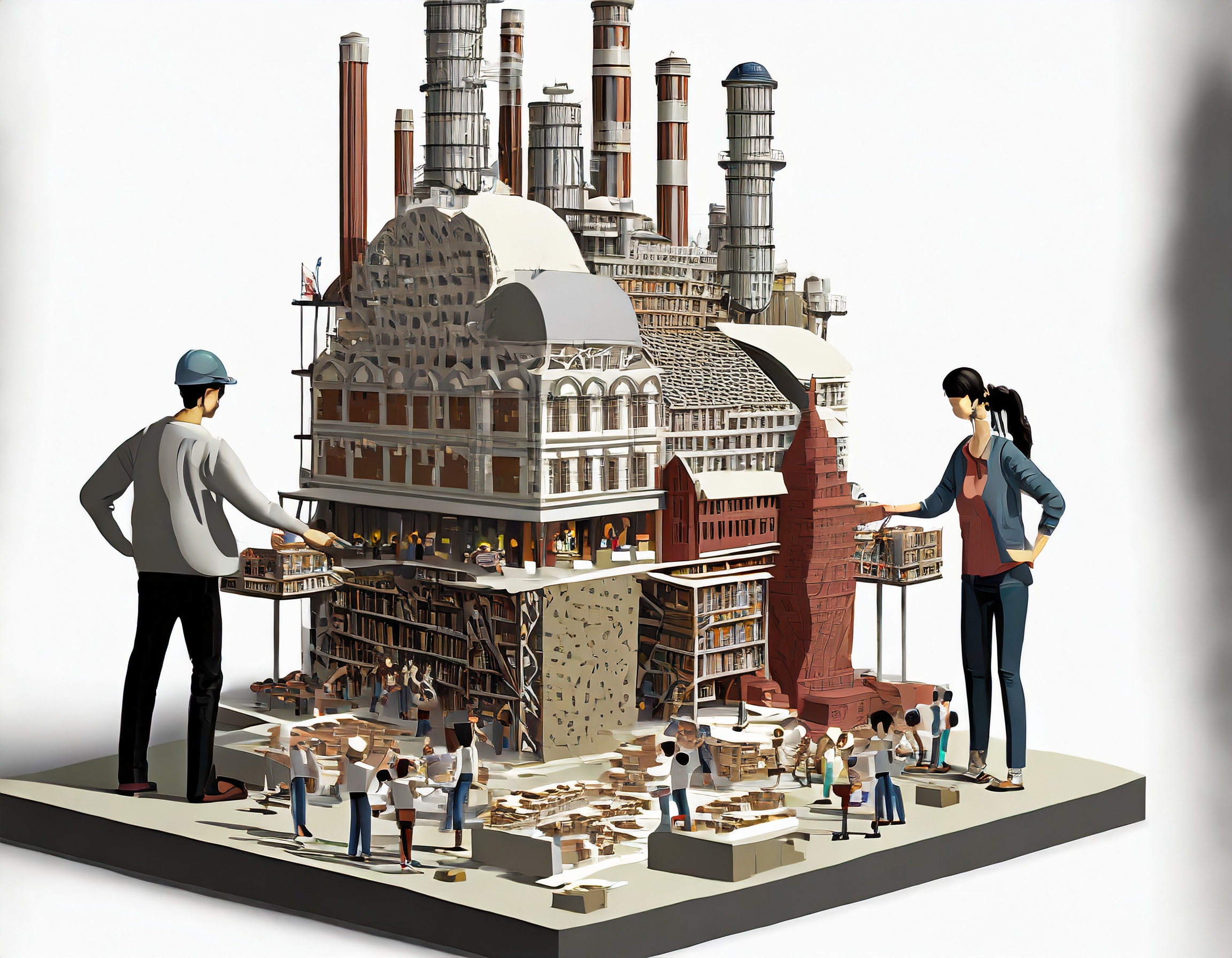
Lankes, R. D. (2026, September 1). Literacy, AI, and the shock. Library Journal, 151(9), 32. Available: https://www.libraryjournal.com/story/literacy-ai-and-the-shock-faith-in-our-future
Librarianship, After the Information Shock
Lankes, R. D. (2026). Librarianship, After the Information Shock. Journal of New Librarianship, 11(2), 140–143. https://doi.org/10.33011/newlibs/21/10
Abstract: In 2019 I wrote of the need for a new librarianship centered on knowledge, and the learning conversation. While that argument holds seven years later, I did not anticipate that those conversations could be held with a non-human conversant. This is causing an Information Shock whose impact goes far beyond the synthetic documents AI can produce, only an extension of the last shock. The deeper disruption is that AI can now instill beliefs, true and false, without accountability. This goes well beyond current efforts in AI literacy. It calls for a full embrace of the new librarianship and a new role for librarians as the accountable conversant in these AI-Human exchanges, standing on the side of the person to ground understanding in evidence and culture. We must claim that role now, because whether this shock unfolds through opaque commercial systems or something for the public good remains a choice.
AI, information shock, and a new information science
Lankes, R. D. (2026, July 31). AI, information shock, and a new information science. Information Matters. https://informationmatters.org/2026/07/ai-information-shock-and-a-new-information-science/
Information Shock: How AI Demands an Evolution of Information Science
Lankes, R. D. (2026, July 3). Information Shock: How AI Demands an Evolution of Information Science. Retrieved from osf.io/preprints/socarxiv/36a97_v1
Libraries, Corrosive AI, and the Trust Paradox
Lankes, R. D., Gustina, M., & Lankes, R. D. (2026). Guest Editorial: Libraries, Corrosive AI, and the Trust Paradox. Public Library Quarterly, 1–8. https://doi.org/10.1080/01616846.2026.2644064
Triptych: Death, AI, and Librarianship
Lankes, R. David, Orr, J. & Chao, Q. (2025). Triptych: Death, ai, and librarianship. Austin, TX: Published in Association with Library Journal.
The Lankes Corollaries Redux
Last year I published “The Lankes Corollaries” in the Access: An International Journal of Nepal Library Association. I have recreated it here…and enhanced it a bit (it was published with a creative commons license). To cite it, please support my colleagues in Nepal:
Lankes, R. D. (2023). The Lankes Corollaries . Access: An International Journal of Nepal Library Association, 2(01), 200–208. https://doi.org/10.3126/access.v2i01.58999
Abstract: This piece explores a series of corollaries to Ranganathan’s five laws of librarianship. These corollaries talk about how librarians work with communities to ensure that service is shaped throughout the community. Such shaping moves libraries away from some pre-determined standard model, and into hyperlocal organizations ultimately facilitating knowledge creation.
Introduction: In 1931 S. R. Ranganathan proposed 5 laws of librarianship (Ranganathan, 1931)
- Books are for use
- Every person his or her book
- Every book its reader
- Save the time of the reader
- A library is a growing organism
While others have tried to expand/revise/or update them (Gorman, 1998, Simpson 2008), the originals stand up. Clearly today we would expand books to resources and even services (e.g., services are for use) and readers have become members or just “people” – as we see that the library is a part of a person’s life – hopefully a significant part.
However, Ranganathan was clearly being aspirational: what we want to be, not so much how we get there. What I propose are 5 corollaries to the laws–guide post for library workers and organizations to achieve these lofty goals:
- The mission of librarians is to improve society through facilitating knowledge creation in their communities
- To be a librarian is to be a radical positive change agent with your community
- A room full of books is a closet, but an empty room with a librarian serving their community is a library
- Bad libraries build collections, good libraries build services, great libraries build communities
- A library should be a safe space to explore dangerous ideas.
The Lankes Corollaries
Lankes, R. David (2023). The Lankes Corollaries. Access: An International Journal of Nepal Library Association. 2(1). Available: https://doi.org/10.3126/access.v2i01.58999
ABSTRACT: This piece explores a series of corollaries to Ranganathan’s five laws of librarianship. These corollaries talk about how librarians work with community’s to ensure that service is shaped throughout the community. Such shaping moves libraries away from some pre-determined standard model, and into hyper local organizations ultimately facilitating knowledge creation.
The Vital Role of Libraries and Democracy Needs Protection
Lankes, R. David (2023). The Vital Role of Libraries and Democracy Needs Protection. Clip de SEDIC, Revista de la Sociedad Española de Documentación e Información Científica. Available: https://doi.org/10.47251/clip.n87.112
ABSTRACT: The current spate of materials challenges in libraries globally calls out for new defenses.Concepts of library neutrality and librarian objectivity fall flat in light of current developments, and against organized challengers not interested in objectivity. New defenses of library services must be based on librarian expertise and activated network of diverse community members. The field needs to strengthen societal protections for librarians in the conduct of their work.
Biblioteche di Comunità in Corea del Sud
My Publishers Weekly piece on community libraries has been translated into Italian by the Laboratori Bibliosociali. You can access it here: https://www.laboratoribibliosociali.it/david-lankes-biblioteche-di-comunita-in-corea-del-sud/?fbclid=IwAR0d4bazhbrv7jpV4FWmvDbzdIPhSCtVajrGwAlBNWIHXfL5UH8mCwpXrnc