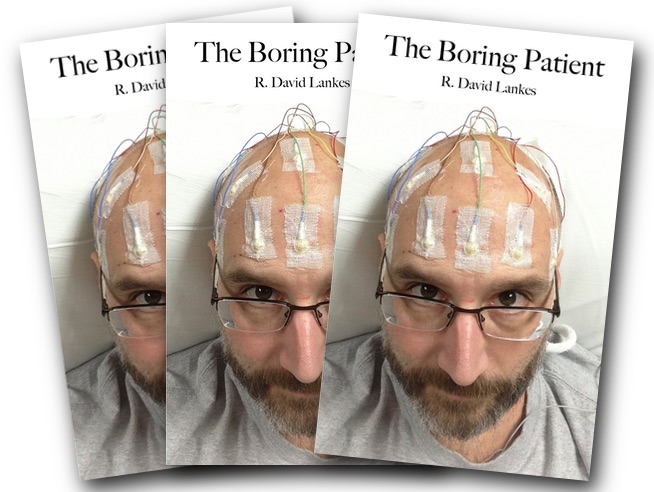
In the run up to my 3rd birthday I’ve put my book on my cancer journey fully online. You can still download it or listen to it as well (or buy a print copy).
Read The Boring Patient Online
Scholar | Speaker | Writer | Teacher | Advocate
In the run up to my 3rd birthday I’ve put my book on my cancer journey fully online. You can still download it or listen to it as well (or buy a print copy).
 Here is a nice short interview on the academic library ideas presented in my new book The New Librarianship Field Guide. To be clear the book is about all sorts of librarians and libraries.
The New Librarianship Field Guide. Lankes, R. David (2016). Cambridge, Ma: MIT Press.
As people are starting to get their hands on the New Librarianship Field Guide I have put up a few items to make it more useful. Check out the Field Guide Related Links by Chapter. It gives you a “tweet able” core concept for each chapter and links to videos and presentations related to the topic. My hope is to keep this as a growing resource, and feel free to send me links and additional resource to add.
I’ve also put up a landing page for the book with quick access to new blog posts and materials around the guide.
[tl;dr version: How does my new book The New Librarianship Field Guide fit into my other books on new librarianship? Librarian or teaching librarians – read the Field Guide. Scholar or librarian looking deeper – The Atlas of new Librarianship is for you. Board member and non-librarians curious about libraries – Expect More.]
While there have been numerous articles and presentations concerning new librarianship, the core of the concept is found in three books:
The three represent stages of thinking and an evolution of the concepts in librarianship, but each remains relevant and each is targeted toward a specific audience.
Published in 2011 the Atlas seeks to present a holistic view of librarianship and is focused on answering the question, “what is a librarian?” It dives deep and wide into concepts such as knowledge and facilitation. It seeks to link the what and how of librarianship to a why founded around a mission: to improve society through facilitating knowledge creation in communities.
Published in 2012 Expect More is written for non-librarians about the field and how libraries as institutions are moving from collection-centered to community centered.
Just released in 2016 the Field Guide is written for front-line librarians and library science students. It is intentionally linear (unlike the Atlas) and accessible by a broad audience. It is loosely modeled as a text book with resources for teaching and discussing the field. It incorporates updated concepts of librarianship from the Atlas and libraries as institutions from Expect More without simply being a digest version of both.
To be clear each represents an evolution of thinking from the previous work. These seek to both promote and document the learning of the field through conversation. As always these works seek to be of value, but don’t seek to be definitive. Any active and vital field will continue to evolve as the world evolves. The goal of any of these books is not to have everyone agree, but to provide a foundation for dialog and healthy argument.
I end with a request to the field. I know that there are aspects of my work and views that people disagree with; that is how it should be in scholarly discourse. From the treatment of knowledge, to the focus on communities, to the political implications of the work there is great room for debate and experimentation. These conversations have and should continue to happen on social media and in conferences. I ask that these conversations be constructive.
Let us all use social media and journals and other forums to debate and argue on the ideas. In the pages of these works you will find an evolution of my thinking that has come from engagement. Librarianship (new, old, or other) is ultimately about society making smarter decisions. I get smarter from engagement with those who disagree often more than a discussion with those who agree. Please share your thoughts in journals, books, and practice. And let us never dismiss useful ideas for failures of the messenger.
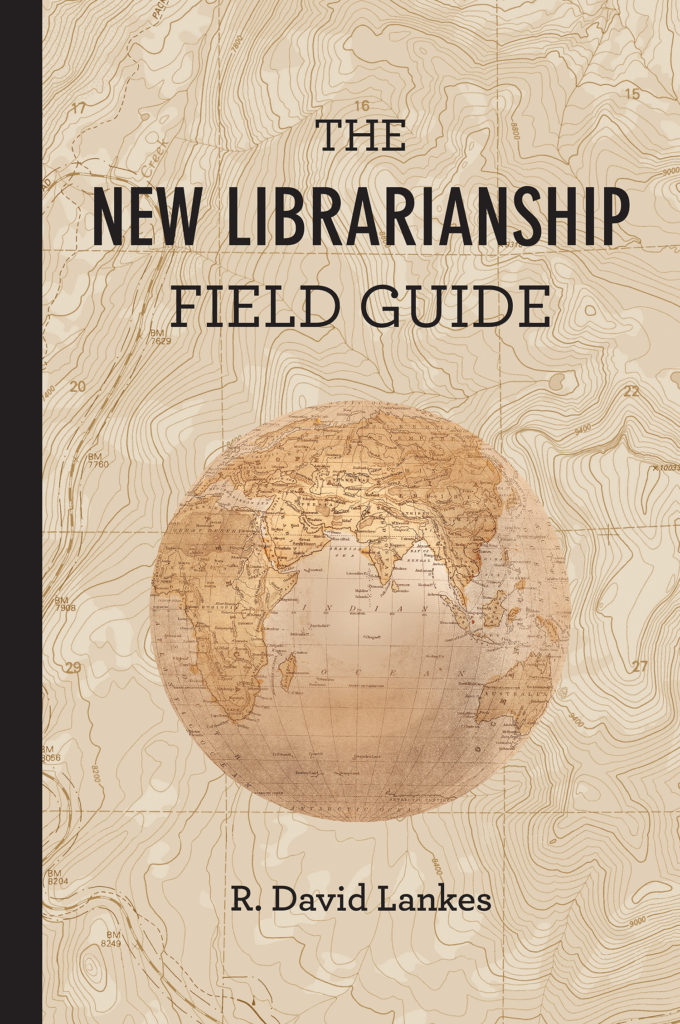
This week I’m posting on my new book, The New Librarianship Field Guide. I’ll be talking about what’s in it, but also how it fits with other work like the Atlas of New Librarianship. MIT Press is shipping these now, and Amazon is taking pre-orders with availability starting the week of May 20th.
To kick us off, here is the information from MIT Press’ Catalog.
 Overview
This book offers a guide for librarians who see their profession as a chance to make a positive difference in their communities—librarians who recognize that it is no longer enough to stand behind a desk waiting to serve. R. David Lankes, author of The Atlas of New Librarianship, reminds librarians of their mission: to improve society by facilitating knowledge creation in their communities. In this book, he provides tools, arguments, resources, and ideas for fulfilling this mission. Librarians will be prepared to become radical positive change agents in their communities, and other readers will learn to understand libraries in a new way.
The librarians of Ferguson, Missouri, famously became positive change agents in August 2014 when they opened library doors when schools were closed because of civil unrest after the shooting of an unarmed teen by police. Working with other local organizations, they provided children and their parents a space for learning, lunch, and peace. But other libraries serve other communities—students, faculty, scholars, law firms—in other ways. All libraries are about community, writes Lankes; that is just librarianship.
In concise chapters, Lankes addresses the mission of libraries and explains what constitutes a library. He offers practical advice for librarian training; provides teaching notes for each chapter; and answers “Frequently Argued Questions” about the new librarianship.
R. David Lankes is Professor and Dean’s Scholar for New Librarianship in Syracuse University’s School of Information Studies.
“David Lankes continues to be a crucial voice in support of libraries as they evolve during tumultuous times. The New Librarianship Field Guide is an invaluable resource for all who care about libraries—and for anyone who wants to help build a bright future for knowledge and democracies in a digital era.”
—John Palfrey, Head of School, Phillips Academy, and author of BiblioTech: Why Libraries Matter More than Ever in the Age of Google
“Libraries + librarians = community: Lankes makes the case and shows his work. He offers a well-structured argument for where libraries in this century need to be going, and how librarians can get them there, answering the question ‘Where in the hell is librarianship going anyhow?’ with charm and grace. Lankes’s invigorating and challenging ideas will help new and existing librarians find their purpose and achieve positive change.”
—Jessamyn West, community technology librarian, Open Library and librarian.net
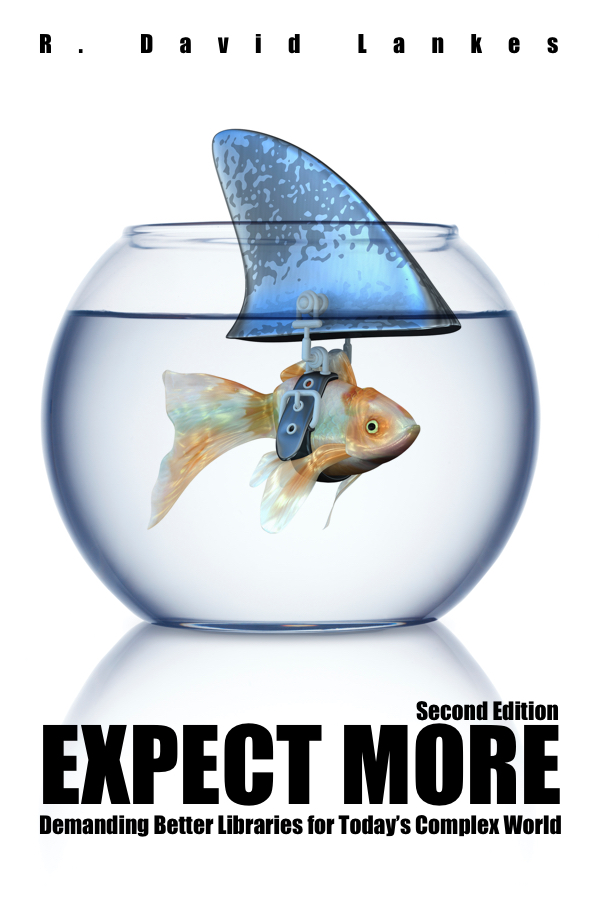
The Second Edition of Expect More: Demanding Better Libraries For Today’s Complex World is now available for purchase (Expect More Collaboratory Members receive free copies).
You can purchase it from:
Paperback:
CreateSpace Online Store (preferred) and Amazon
eBook:
If you are interested in bulk discounts please contact me at rilandpub@gmail.com
Thanks to all the Collaboratory partners for their help. Keep an eye out for Greater Expectations, the Expect More Workbook for engaging your community in conversations.
Here is a brief Changelog to highlight major changes:
Expect More:Demanding Better Libraries For Today’s Complex World Second Edition. Lankes, R. David (2016). Jamesville, NY: Riland Publishing.
There’s a lot going on at the Expect More Collaboratory at the turn of the year. Check out the update:
The Expect More Collaboratory is about to produce it’s first deliverable: the second edition of the Expect More book. This will be quickly followed by an Expect More Workbook and, in the summer, online training and advocacy materials.
With the release of the second edition the downloadable and print version of the first edition will be withdrawn from the web and online markets like Amazon (Collaboratory partners will be able to still download the first edition as well as the second edition through the Collaboratory site). The second edition of Expect More as well as the Workbook will be available for purchase by non-members. This will start happening January 1st.
Just as a reminder, Expect More Collaboratory members get 25 copies of the printed second edition, a print copy of the Workbook, unlimited access to the ebook versions and of course access to the coming online materials.
A note of thanks and gratitude to all who helped make Expect More such a success. It has been sold, accessed, and downloaded over 20,000 times!
If you would like to be part of the future of Expect More please consider joining the Expect More Collaboratory.