I am posting a chapter a week of my book The Boring Patient. You can download the ebook or listen to previous chapters here: https://davidlankes.org/?page_id=8390
Chapter 8: Your Side Effects Will Vary
Scholar | Speaker | Writer | Teacher | Advocate
I am posting a chapter a week of my book The Boring Patient. You can download the ebook or listen to previous chapters here: https://davidlankes.org/?page_id=8390
Chapter 8: Your Side Effects Will Vary
I am posting a chapter a week of my book The Boring Patient. You can download the ebook or listen to previous chapters here: https://davidlankes.org/?page_id=8390
Chapter 2: Sick and Tired in Amsterdam
The California Library Association has joined the Expect More Collaboratory.
Expect More: Why Libraries Cannot Become STEM Educators. Lankes, R. D (2015). Public Libraries and STEM Conference.
ABSTRACT:
America’s public libraries can play an important role in furthering STEM education. However, this will be true only if STEM learning efforts focus on librarians and librarians acting as facilitators. Any effort to transform librarians into STEM experts will have limited success given the increasing number of roles librarians are being asked to take on. At the same time, the current belief among many librarians that they can only offer programming in which they feel comfortable or have expertise will strongly constrain STEM programming in libraries. Librarians must instead create platforms within a community to unleash STEM expertise within the communities they serve. This will involve changing the concept of libraries in the minds of librarians and community members alike. Librarians must facilitate the use and sharing of STEM expertise already existent in the community by the community. Librarians ultimately must see their communities as their collections, not simply materials in the building.
 http://www.lpi.usra.edu/education/stemlibraryconference/events/Lankes_Expect_More_PRINT.pdf
“Participatory And Transformative Engagement In Libraries And Museums: Exploring And Expanding The Salzburg Curriculum” R. David Lankes , Michael Stephens, Melissa Arjona (2015). Volume 56, Supplement 1. Journal of Education for Library and Information Science. Available: http://www.dpi-journals.com/index.php/JELIS/article/view/1323
Four Years ago I wrote Expect More: Demanding Better Libraries For Today’s Complex World to start a conversation between librarians and the communities they serve. Since that time thousands have used the book to start conversations, teach students, do board development, and even shape director and dean searches. The time has come to take Expect More to the next step: The Expect More Collaboratory.
This is a call to join partners in expanding Expect More into a comprehensive and expanding set of community building resources. These resources will include online learning events for library decision makers, a physical and digital workbook, and an ongoing series of engagements to advocate for greater community focus and involvement in libraries. The Expect More Collaboratory will deliver a multimedia web-based curriculum for use by librarians with boards, principals, provosts, and communities.
So consider this a call for crowd sourcing. Please help in preparing our communities for better libraries. I’ve put together a site for more information and a brief video call for participation.
Expect More Collaboratory (http://www.ExpectMoreLibrary.com)*
*Please note this used to point to the Expect More World Tour, and you may need to refresh your browser. The direct link is https://davidlankes.org/?page_id=7974
A Message From the Lankes Family:
Please join us on Wednesday, June 3rd, from 1-7p.m. for the 2nd Annual Lankes Family Red Cross Blood Drive. It will be held at Holy Cross Church in Dewitt, NY.
David was diagnosed with Hodgkins Lymphoma in 2013. He underwent a stem cell transplant and is now 1 year cancer free! This blood drive is a way for our family to give back to the individuals who helped save his life.
Last year, our goal was to collect 50 units of blood and thanks to the generosity of our friends and community, we were able to collect 66 units! These units helped 198 individuals! Please consider taking time during your day to help us save lives. To schedule your appointment, call the Red Cross at 1-800-RED-CROSS or visit www.RedCrossBlood.org.
All donors will also receive a Red Cross t-shirt!
As an added incentive, and to tell you our story, We’re making David’s latest book, The Boring Patient, available as a free download leading up to the event.
Greetings all. There was a great deal of activity around my new book, a librarian-oriented follow-up to the Atlas of New Librarianship, at the beginning of the year. Well, it is 4 months later and there has been a lot of progress. Of course most of that progress is between me and my word processor, so I thought it would be useful to bring folks up to speed.
The first update is that the working title of the book has changed. The Radical’s Guide to New Librarianship is now The New Librarianship Field Guide. Folks made it very clear in my call for input they were looking for a book that was more linear, filled with more actionable examples, and was at it’s core about implementation. So the Field Guide now includes lots of examples, discussion questions, and field observations on implementing and teaching these ideas. To be clear I still talk about librarians as radical positive change agents.
I’m changing the pages on my site to reflect the new working title over the next few days. All the “Radical Conversations” will remain.
The other reason for the change is that Field Guide is being designed for use on the go. Not only will it be a highly portable paperback, but it will be available from the get go as an ebook. So the hope is that you can use it on the front lines with librarians and other library staff.
The big update is that the first really rough draft is now out for comments from the New Librarianship Collaborative (Wendy Newman, Kim Silk, and Lauren Britton). I’m including the current table of contents below and I need your help.
You’ll see that Chapter 19 is titled “FAQs (Frequently Argued Questions).” I’m looking for your questions or the issues that pop up when you are trying to implement the community-centric, community as collection idea. I can’t promise to include them all, but I would like to provide responses to as many as possible. You’ll see a few examples already under that chapter (and a special thanks to Lane Wilkinson for letting me use his blog post to get the ball rolling).
So email me, or use the comments below.
Here’s the current Table of Contents:
UPDATE: The URL has been redirected (though it can take up to a day for the change to take effect).
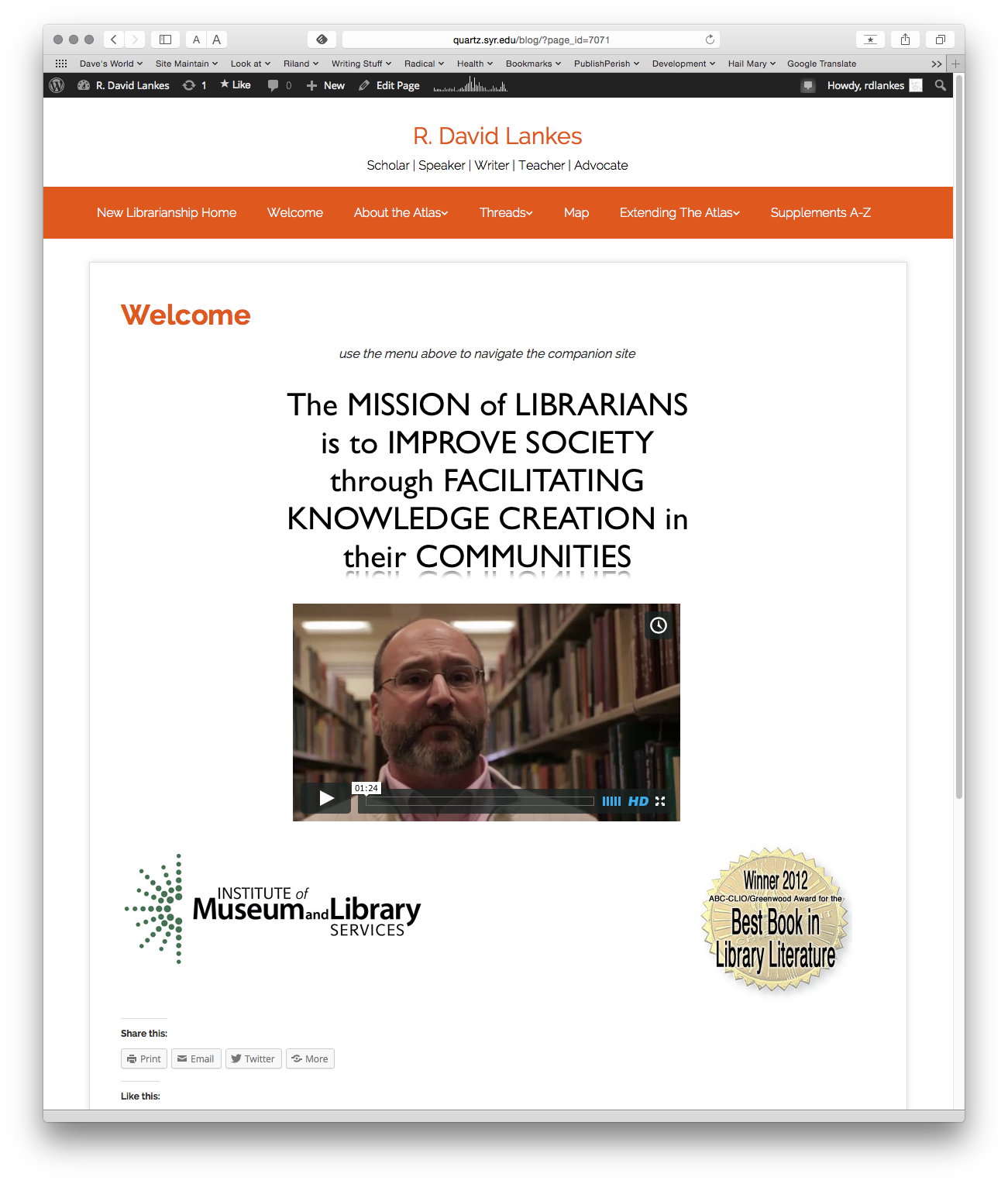 The contents of the Atlas of New Librarianship’s companion site are moving from a stand alone server to my site to join all the other New Librarianship activities.
You can access all that content now here: https://davidlankes.org/?page_id=7071
Next week I will begin redirecting the URL http://www.NewLibrarianship.org to the New Librarianship pages of my blog. So you can use that URL to get information on the Atlas, Expect More, and all related activities.
I’d like to thank the IT folks at ALA for hosting the site to this point. I’d also like to thank Liz Crowder, my great Faculty Assistant for doing the moving.
Please let me know if you see any issues with the new site.
So I am experimenting with more self-publishing platforms. Today is issuu.com. This is the free version of the tool, so there will be adds, but you can use this to embed the book in any webpage you’d like:
Special Note: Don’t use the “Order Print” option, as print copies are cheaper through Amazon (and, you know, I get a royalty there).
This is a nice platform to keep formatting and visuals. However, you have to spend monthly money to add features such as annotations. Medium.com seems a better system for getting out pieces for reading and comment.