Going to the South Carolina Association fo School Librarians? Come and hear what the University of South Carolina’s School of Library and Information Science has been up to and provide feedback.
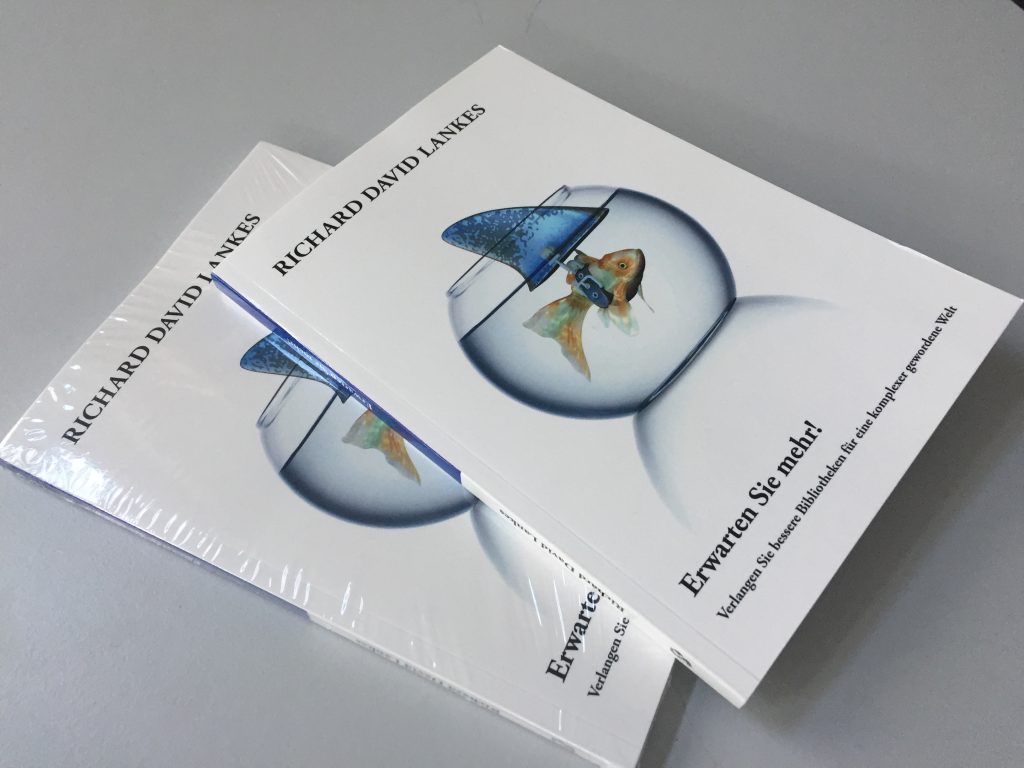
PASSWORD-Online, the German online magazine, has chosen the German Edition of David Lankes Expect More as the “book of the year 2017.”
A very special note of thanks to Prof. Dr. Hans-Christoph Hobohm and his team of translators. He and his team went well beyond simply translating words, but did an amazing job translating and promotion the spirit of Expect More and pushing for transformed libraries in Germany.
I’ve been having some tech problems with my site for a while now (sorry if it has been slow to load). It seems I’ve figured them out, so a lot of changes I made to try and workaround the site (like a new theme with way too big a picture of me on the homepage) can now be done away with. So I’ll be updating the look to the site in the next few days. All the content will stay in place and links won’t break. Let me know if you see problems.
Here are my remarks for Jim Neal’s Presidential Program was “Are libraries neutral?” I was on the “con” side of the debate. tl;dr version – no they are not.
The video of the session should be available soon, but some of the participants have posted their remarks (I’ll add as they come online here):
My fellow librarians I want to get up here and deliver an impassioned speech, full of alter calls and homilies on how you cannot be passionate advocates for the good of your communities and still claim to be neutral. I want to appeal to your emotions and throw out tweetable lines like “I’d rather be damned for honest efforts to improve the world, than lauded for my objectivity.” I want to point out that freedom of speech, that we take as a given, was once a treasonous concept and has never been equivalent to endorsing speech nor a guarantee from consequence of that speech. I want to remind you that you became librarians to make a difference, to uphold a core of values and that you are professionals, not neutral clerks in a library machine.
I want to do that, but I won’t. It would make us feel good. Well, it would make me feel good. But it would ignore the very real consequences of accepting that librarians, and the libraries that we build and run, are not neutral organizations. Nor will I have a philosophical debate on whether human neutrality is even possible as my colleague has already done so including citations to studies and better thinking than I am capable of.
Instead, I will make a single proposition, and ground it in the pragmatic nature of our profession.
School librarianship is central to the mission and work of the School of Library and Information Science at South Carolina. School Library students make up nearly 40% of our graduate class. In addition to this position we already have searches underway for the Augusta Baker Chair in digital literacy and youth and an instructor to work with our South Carolina Center for Children’s Books and Literature. We run projects like Cocky’s Reading Express to encourage literacy in the neediest schools in the south. We have grants from the Hearst Foundation to develop community literacy initiatives that team teachers, school librarians, public libraries, and civic institutions. We have begun Library Scholar program that teams with school districts to create cohorts of transformation teacher librarians from the teaching ranks. Our first cohort is with the Charleston County School District. Where other programs are shrinking or eliminating school library programs, we are growing ours.
If you are looking for the place to advance school librarianship scholarship, teaching, and advocacy you will find no better place. If you are interested, you will be part of building a vision that is transforming library service around the globe.
I and a number of faculty will be at ALISE and MidWinter if you’d like to talk.
Happy New Year. It is a time many take stock and resolve new actions for the coming year. This is particularly true for SLIS. In my Thanksgiving message, I talked about some of the great work and achievements of SLIS over the past year. For the new year I’d like to talk about resolve, and moving ahead.
Many see a school as a sort of repetitive machine that offers classes, graduates students, and then starts again. SLIS is not such a machine. SLIS is on a mission. We seek to improve the world one community at a time. To a group of students, faculty, staff, alumni, and partners on a mission a new year is a time not to dwell on the past or seek to tinker with a process – it is a time to rededicate ourselves to our endeavor.
We improve communities in our classrooms preparing a missionary force of librarians, information scientists, and scholars that will go out into society and help businesses, towns, government, and more make smarter, more knowledgeable decisions. We do this in our offices, centers, and studies seeking to understand how the world operates and improves. We do this through our literacy efforts bringing the power of reading to our most vulnerable citizens – children. We do this in talks and papers and lectures and videos and books.
Being on a mission is hard work. It takes constant effort to seek out the new and better. It takes work to face down the problems of the world and seek solution. It is a hard choice we make. Librarians see our communities struggle and yet must still see the hope in their aspirations. Our information scientist must constantly weigh what is technically possible with the costs of preserving privacy, security, and our ethics. Scholars must seek the truth in a world too ready to dismiss expertise for self-interest. And yet we must continue to do so. We have a mission.
The mission needs all of you. In the weeks and months ahead you will hear a steady stream of calls for help and unity.
You will hear about a new Library Scholar program we are beginning with the Charleston County School District. SLIS is partnering with the Charleston schools to prepare a cohort of school library leaders focused on Charleston’s school libraries, but connected internationally. We hope that Charleston Library Scholars will be joined with cohorts from other school districts, public libraries, and other institutions across the state and nation.
You will hear about a process to examine our LIS curriculum. Librarianship is a living and vibrant profession. It serves communities in constant flux. Our curriculum must continue to be dynamic and rigorous. We will be reaching out in the coming months to alumni, students, and our partners to ensure a responsive and innovative program. We seek to marry theory and practice in a true learning laboratory.
You will hear about an effort to restructure our National Advisory Board. While all of you are encouraged to share your thoughts and ideas, the NAC has served a vital formal role in the school. At the urging of the NAC we are going to set up a more structured and powerful advisory system.
You will hear about a new mentoring program for our library students. Our Diversity Leadership Group has already begun this work, but it needs all of our involvement. We will connect incoming students with our school, public, academic, medical, and special librarians as well as creating deeper connections into archives and cultural heritage.
You will hear about a growing undergraduate program. Built on the foundations of our library program, the undergraduate degree expands our footprint on campus, provides resources to the entire school, and prepares the CIOs, the mayors, the provosts, and professionals that in turn support our librarians. In a year the program has doubled, and this year we will be expanding the minor in information science to explore emerging opportunities in the Information Age such as data science, social networking, and the implications of large scale algorithms.
And yes, you will hear about calls for support. Your generous contributions support scholarships, help develop new scholars, and bring much needed service to needy schools.
So, here’s to a happy new year. Here’s to an ongoing conversation that we call a school. Here’s to a mission that can sustain us in good times and bad. This year and the years ahead will see new faces join the mission, and familiar colleagues take the mission to new communities. That is how it should be. The mission is larger than any one of us.
Today we celebrate, remember, evaluate, and rest. Tomorrow? Well, we have a world to save…one community at a time.
I realize that it can be difficult to find things to be thankful for in the news this year. It may seem like a daily onslaught of tragedies, hate, and strife. It is impossible for a community such as ours, dedicated to improving society, not to be moved. Hurricanes, mass shootings, growing international tensions, racists marching, sexual harassment disclosures…its enough to drive anyone to withdraw.
But if you seek to change the world, to improve society, you must first see the world as it is. In addition to being a community of service, we are also a community of scholars. We match our passion with dispassionate tools of research. We study how libraries respond to hurricanes. We examine how first responders serve people with disabilities. We study school librarians faced every day with the ravages of poverty. We mine millions of tweets to understand the threats to democracy. We research faith communities. We travel the globe to understand how policy effects the diffusion of ideas.
And then, we act. Because in the face of great need, great effort it required. Our faculty, staff, students, alumni, and partners engage. We use archives to fight racism in our schools. We travel the state to inspire children to read, giving them books, hope, and self-worth. We build libraries as places of creation and community. In our schools, universities, corporations, governments; online and off; in palaces and huts; in South Carolina, the nation, and the planet we build the world our communities deserve.
That work gives us much to be thankful for this year. Our enrollment numbers are up. We are hosting national events, and have a significant presence at national and international conferences. We publish in top journals. Our alumni run the best libraries in the nation.
I am truly thankful to be part of such an incredible and caring community.
“Claiming Victory and Moving On” Rutgers University Beta Phi Mu Fall Speaker. New Brunswick, NJ.
Abstract: The rise of information as an idea and discipline since World War II has been driven by the belief that information underlies, and can change, just about every other discipline and industry. Library science scholars, and information scientists have sought to not only understand the nature of information, but to use technology to shape how work is done, and how we see the world. A worldview around information took shape and succeeded to the point that it is hard to identify an industry that is not, at least in part, an information industry. Manufacturing has become computer supported and built upon global logistical networks. Health has become a product of data mining from patient predicted outcomes, to pharmaceutical development, to personal monitoring devices. Journalism, law, even the arts has begun to adopt digital humanities. However, when every industry is an information industry – that is where industries and disciplines have adopted concepts from the information domain and made them their own – what is left in library and information science? What is core to our field that is not part of computer science, or communications, or psychology? Lankes will layout a new emerging world view based not on data, or information, but knowledge and meaning. He will talk about the necessity to shift the narrative in libraries and iSchools and propose an agenda focused on communities and the common good.
Slides: Slides in PDF
Audio:
The College of Information and Communications at the University of South Carolina seeks an outstanding candidate to fill the Augusta Baker Endowed Chair in Childhood Literacy, the first academic chair at the University of South Carolina honoring an African-American woman. Augusta Baker was the first African-American Director of Children’s Services at the New York Public Library and former Storyteller-in-Residence at the University of South Carolina.
The College of Information and Communications is seeking a candidate that will build on Augusta Baker’s legacy by advancing our knowledge of youth literacy and services in traditional and digital environments. The successful candidate will provide national and state leadership in the teaching, research, and service missions of the School of Library and Information Science (SLIS). The Chair will be actively involved with the South Carolina Center for Children’s Books and Literacy, an initiative dedicated to research, development, and community involvement to eliminate illiteracy in South Carolina and across the country.
The SLIS-MLIS program is fully accredited by the American Library Association (ALA), and its school librarianship preparation program is approved by the Council for the Accreditation of Educator Preparation (CAEP). In addition to the MLIS degree, SLIS offers the Ph.D. and two other post-master’s degrees. The School also offers an undergraduate degree in information science. The University of South Carolina is an affirmative action, equal opportunity employer committed to building a culturally diverse faculty, staff, and student body, and is responsive to the needs of dual career couples.
The University of South Carolina School of Library and Information Science in Columbia invites applications and nominations for a tenured faculty position at the Associate or Full Professor level to begin fall 2018.
Shape the future of library and information science. Pursue your interests in a diverse, intellectually stimulating, and multi-disciplinary environment that provides support and encouragement as part of a collaborative work culture. Be a strong voice in the shaping of a growing information science undergraduate program. An earned doctorate in library and information science or a related field is preferred. This position requires a clearly articulated research agenda and enthusiasm for and excellence in teaching in both online and face-to-face formats.
The School is particularly interested in a candidate with specializations in one or more of the following areas:
Information Science
Academic Libraries
Research Methodologies
Information Retrieval
Archives
Digital Repositories
Selected candidates will be expected to help with the school’s commitment to diversity through research, teaching, and service.
Responsibilities:
Instruct undergraduate and graduate courses in both face-to-face as well as online environments
Mentor and advise undergraduate and graduate students
Participate in instruction, research, publication, grant writing, and other scholarly activities
Provide service to the department, college, university, profession, and community
The University of South Carolina School of Library and Information Science in Columbia invites applications for a non-tenure track 11-month instructor position.
Shape the future of library and information science. Pursue your interests in a diverse, intellectually stimulating, and multi-disciplinary environment that provides support and encouragement as part of a collaborative work culture. Those with an earned master in library and information science, information technology, or a related field are encouraged to apply. This position requires experience and enthusiasm for teaching in both online and face-to-face formats. Non-tenure track faculty at The University of South Carolina are engaged in instruction, service, administration, and research.
Responsibilities:
Instruct undergraduate and graduate courses in both face-to-face as well as online environments
Remain current in developments and trends in subject and research areas
Mentor and advise undergraduate and graduate students
Support the mission of the South Carolina Center for Children’s Books and Literacy including Cocky’s Reading Express, this could include fundraising and grant writing
Provide service to the department, college, university, profession, and community
The School is particularly interested in candidates with a specialization in one or more of the following:
Young Adult Services
Digital Literacy
Children’s and Teen Literature
School Libraries
Selected candidates will be expected to help with the school’s commitment to diversity through research, teaching, and service.
The School of Library and Information Science invites applications from exceptional candidates for a visiting position for the fall and spring terms of the 2018-19 academic year. Specifically, we are looking for a visiting professor to collaborate with a faculty dedicated to social impact through information, knowledge, and librarianship. Rank will be determined commensurate with the candidate’s qualifications and experience.
The School of Library and Information Science faculty is accomplished and engaging. It is a vibrant intellectual culture at the flagship campus of the University of South Carolina. With our colleagues in the School of Journalism and Mass Communications we make up the College of Information and Communications. The successful candidate will be working with a school with extensive regional and international ties
Remarks prepared for “Biblioteche per Apprendere” Rome, Italy
I have taken to trying to summarize my talks in the form of a single tweet, just in case a certain US President is paying attention. So here it is:
“Believing that a collection alone will improve learning is like believing that a bag of groceries can magically turn itself into a soufflé.”
Let me begin my remarks by thanking the organizers of this event. Let me also apologize for reading a speech. I rarely restrict myself to a script, but I see my topic today as too important to leave it to the inevitable ramblings of jetlag.
To be clear I don’t think that even a script will prevent me from my true nature as an excitable American. What I would like to talk to you about today is nothing less than using your libraries as a mechanism to dramatically advance your educational system, and thereby improve scholarship, innovation, economic development, and citizen participation. But I am getting ahead of myself.
Let me start with two seemingly simple propositions.
Proposition 1: The core of librarianship is knowledge – specifically facilitating knowledge creation. That is to say that the reason we have libraries is to help a community get smarter, to create knowledge – to learn. That community may be a school, a town, a business, a ministry, or even a whole country.
Proposition 2: Knowledge is a uniquely human thing. Books are not knowledge – they are the result of knowledge. Knowledge can’t be shelved, or printed, or downloaded. Being uniquely human, it is not cold or merely a set of objective facts. Knowledge is passion and belief and the insatiable curiosity that drives us all.
Now let us put these two propositions together.
First, we see that libraries are not collections of books or databases or documents. Those are tools to a much larger end. Why do libraries collect books? To help a community learn. Why do libraries lease databases? To expand the knowledge of the community. The knowledge of the community – not the information of the community, or the holdings of the community, but the passionate, intimately human, finding one’s place in the universe, knowledge.
Secondly, we must understand that the true power of the library is not in those collections – what good is a book to a student that can’t read? The true power of the library is engaging in knowledge, and that requires people. The true power of a library is the librarian – the professionals and scholars who staff the library.
Thirdly, we see that the ultimate collection of the library is not in those tools, but the community itself. The true collection of a library is not made up of documents or manuscripts, but in the innovation, experience, and brilliance of the community served. It is the same with universities. The value of a university is not buildings or titles, or degrees, but the faculty, students, and staff engaged in a quest for truth and understanding. So too is it with a library.
And now, with the propositions of libraries and knowledge, and the realization that libraries are centered in communities, curated by librarians, and ultimately consist of the knowledge of the community members we can, in typical excitable American style, talk about the amazing opportunity before you today.
I believe that by Italy joining a growing global renaissance in librarianship you can transform the Italian educational system into the envy of the world, and an engine for expanded innovation, economic development, and an engaged citizenry.
I know that sounds grand, but if we don’t believe ourselves capable of the extraordinary, we too often settle for the ordinary. In these days where technology has obliterated space and time in how we access information, where the Vatican Library is as much about liquid cooled petabyte computing as ancient manuscripts, where our communities face the largest human migration since World War II, where our global politics redefine the very map and nature of Europe, how can we afford to be anything other than bold?
It begins with our primary schools. You have already begun investing in school libraries. This is great and it should be expanded, but it should also be targeted. The overwhelming evidence demonstrates that school libraries improve student outcomes and performance. However, that same research shows that the performance gains do not come from a room, or a collection, but the presence of a trained teacher-librarian. Let me just say that again. School libraries improve student performance, but when there is a dedicated teacher-librarian.
Teacher-librarians are not clerks or burnt out teachers. An effective teacher-librarian is a trained educator. They are trained in pedagogy, they work directly with teachers to enrich curriculum, and most importantly, they have their own curriculum in information problem solving. In primary schools, teacher-librarians should be in every school teamed with language arts teachers to increase literacy. They should be teamed with history teachers to expand the resources used to critically analyze historical events. Teacher librarians should be at the center of inquiry driven instruction where even at the age of 8 and 9 students merge math and science and literature to explore topics they are passionate about.
At the secondary level, professional teacher-librarians should not only support the other subjects, but should own and engage students around information literacy and problem solving. Teacher-librarians at the secondary level offer the best place to help Italian citizens critically analyze and engage in the media world around them. What good is a literate student that reads fake news? What good is a stand out science student who is easily deceived on the Internet? What value to society is a well-trained citizen unable to tell truth from conspiracy or legitimate news from propaganda?
I don’t think it is a coincidence that in the US and the UK-where school library programs are being cut and professional teacher-librarians are being replaced with volunteers-there is a growing crisis in falsified news and a growing distrust of the media and science. I am literally begging you to learn from our mistakes.
In every school in every town in every region of this country you need a dedicated corps of teacher-librarians preparing the leaders of tomorrow. Why so much emphasis on librarians in this process? After all you, as has nearly every country on earth, invested in improving classroom teaching. Why librarians then? Because there is no other profession better to situated to work across the curriculum. Advances in the classroom will never provide the improvement you seek until you have an effective way to connect those improving classes together. Teacher-librarians, when properly trained, act as a bridge that binds together physics and philosophy, language and linear equations, chemistry and civics.
And this is where our grand vision begins to get realized. Because not only will we connect course to course, but classroom to community. An investment in teacher-librarians matched with a reinvigoration of libraries in the public and academic sphere means we put in place a proactive knowledge infrastructure for the whole country. A person learns in a classroom, and at home, and with their friends. From a book, and a YouTube video, and a 3d printer.
When we all made huge investments in the internet we were told of the great potential. Bringing fiber to the countryside, wireless to our schools, and mobile broadband in our cities was supposed to spark a wave of invention, democratization, and economic growth. When anyone could download the latest discovery to their phone or share their newest song with the world, things were supposed to change. A vision of data and information talked of a new global community.
Instead, all too often we have built new monopolies streaming content to consumers who are asked to trade privacy for access. In too many cases our students and our citizens have become products.
Why, because our investments in an information infrastructure was not matched with an investment in a knowledge infrastructure. We provided access where those with knowledge of computing, marketing, and data analysis were able to prosper. What we need now is a matching knowledge infrastructure that empowers all of our citizens to master and manipulate these technologies.
Why librarians? Once again what part of society today spans from birth to old age? What other part of society links the scholar to the farmer? By linking our public libraries in Pistoia, with our teacher-librarians in Perugia, to our academic librarians in Florence, to our medical librarians in Calabria; Italians-you-have the power to ignite the potential of the people. With the infrastructure already in place, with the investments already made, education becomes a tightly coupled platform for innovation.
Don’t think, however, this will be easy, or the result of a simple declaration. First, we need to prepare the librarians and teacher-librarians in this new knowledge-centered thinking. Gone are the days when library education could be solely about cataloging. Gone are the days when scholars could wrestle with theories in their ivory tower while practitioners focused only on the stacks before them.
It is time to throw open the doors and windows on the libraries. It is time for the buildings to become community hubs, the new piazza, and the librarians a missionary force going into the community.
I apologize if this comes across as a visitor lecturing to his hosts. I am, once again, an excitable American. But I ask you – isn’t that what Italian libraries and Italian schools need? Excitement? I talked before of a library renaissance. It harkens back to a time in Italian history where humanism took firm footing. Where passionate polymaths literally changed how man saw his relationship to the universe. Where a cosmos of perfect celestial spheres was shattered for a universe so much grander and more complex. Let us, you and I, here and now, dare to think bigger and create a society once again at the forefront of the world.