The Future of Librarianship

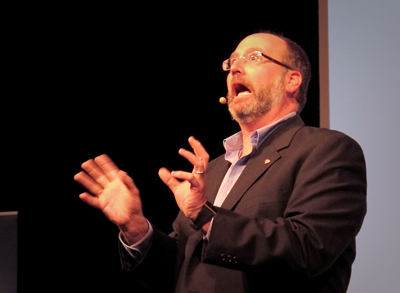
“The Future of Librarianship” Delaware Library Town Hall, Dover, DE.

Abstract: Take away the librarians, the staff, but leave the books, the computers, and the architecture and for a week you will have a fine sculpture of a library that every day will become more and more a snapshot of the past. But throw out the books and buildings and leave a dedicated corps of library professionals…invite the public in and they will construct the future.

Now more than ever, the future of Delaware, the future of any state is not in riches we pull from the ground or the glass we send streaming into the sky, but in the decisions and talent of the citizens. They are not passive consumers of libraries, or content, or an audience to democracy, but the very reason we are all here. They deserve a new librarianship, a new library that enables radical positive change. That is focused on knowledge and learning, that is focused on a conversation that is Delaware.

Slides: https://davidlankes.org/rdlankes/Presentations/2011/Delaware.pdf
Audio: https://davidlankes.org/rdlankes/pod/2011/Delaware.mp3

Screencast:

Atlas Reading Group

From the New Librarianship website:

Hello librarians and friends! I’m Emma Montgomery, a LIS graduate student at Syracuse University, and for six weeks this summer I’ll be hosting a Twitter reading group for The Atlas of New Librarianship. Starting the week of June 20th I’ll be reading a thread of Dr. Lankes’ book each week and posting thoughts and questions on Twitter using the hash tag #atnewlib. I hope you will all join me! The goal is to have a community through which we can engage with and explore the issues raised in the Atlas. So grab your copy of the Atlas, tell your friends, and I’ll see you on Twitter!

Please join in!

Lankes to Participate in Salzburg Global Seminar

Salz
I have been invited to be a part of the Salzburg Global Seminar “Libraries and Museums in an Era of Participatory Culture” which will be held in Salzburg, Austria in October. The session is being convened jointly by the Salzburg Global Seminar (SGS) and the Institute of Museum and Library Services (IMLS).
From the seminar description:

Abstract

As key stewards of our culture and heritage, libraries and museums have traditionally enjoyed, and to a great extent still do enjoy, a unique role and special responsibility within societies around the world. But as economic disruptions and rapid technological innovation have brought about dramatic societal changes, libraries and museums, too, are being forced to revisit and rethink their own roles and responsibilities within these changing societies. The 21st century indeed poses perplexing challenges, but at the same time offers intriguing new opportunities for libraries and museums. It is a critical moment for leaders within libraries and museums to reflect creatively and strategically about the role and place of their institutions in an era of participatory culture and to recognize and seize the opportunity for reorientation and reinvention.

Building on the Institute of Museum and Library Services (IMLS) initiative The Future of Museums and Libraries as well as on past museum and library sessions convened by the Salzburg Global Seminar, this session will bring together approximately fifty leaders, advocates and constituents of libraries and museums, cultural and educational policymakers, cultural sector researchers, representatives of library and museum education programs, technology experts, sociologists, journalists, and library and museum association representatives to debate the changing roles and responsibilities of libraries and museums in their societies. The participants will consider the following key areas: societal changes that are shaping the future of museums and libraries; collaboration; education and training; communication and technology; sustainability; value and values. Together, the participants will develop a set of recommendations for libraries and museums to meet the new challenges posed to them in this era of participatory culture. The recommendations, in turn, will be shared with the larger library and museum community worldwide.

This session is being convened in partnership with the Institute of Museum and Library Services in Washington, D.C.

SALZBURG GLOBAL SEMINAR

The Salzburg Global Seminar is a unique international institution focused on global change—a place dedicated to candid dialogue, fresh thinking, and the search for innovative but practical solutions. Founded in 1947, it challenges current and future leaders to develop creative ideas for solving global problems, and has brought more than 25,000 participants from 150 countries and regions to take part in its programs. The Salzburg Global Seminar convenes imaginative thinkers from different cultures and institutions, organizes problem-focused initiatives, supports leadership development, and engages opinion-makers through active communication networks, all in partnership with leading institutions from around the world and across different sectors of society. To learn more about the Seminar, please visit www.salzburgglobal.org

THE INSTITUTE OF MUSEUM AND LIBRARY SERVICES

The U.S. federal Institute of Museum and Library Services is the primary source of governmental support for the nation’s 123,000 libraries and 17,500 museums. The Institute’s mission is to create strong libraries and museums that connect people to information and ideas. The Institute works at the national and international levels and in coordination with state and local organizations to sustain heritage, culture, and knowledge; enhance learning and innovation; and support professional development. To learn more about the Institute, please visit www.imls.gov.

Grand Challenges of Librarianship

“Grand Challenges of Librarianship” Keynote Swedish Library Association’s Annual Conference 2011, Visby, Sweden.

Abstract: Instead of facusing on the future of our communities we all too often seem to chase them through technology hoping to find new relevance for our collections and buildings. In such a world every new tool is a potential threat, any perceived encroachment into documents or services an enemy to be rationalized and dismissed. This must stop. We must first identify Grand Challenges facing our communities and then evaluate our mission in light of these challenges. Only then can we refine, adapt, and create tools to improve society.
Slides: https://davidlankes.org/rdlankes/Presentations/2011/Sweden-Lankes.pdf
Audio: https://davidlankes.org/rdlankes/pod/2011/Sweden.mp3

Screencast:

Radical

“Radical” Keynote Florida Library Association’s Annual Conference 2011, Orlando, FL.

Abstract: We must go further. We must go deeper into our communities. We must bring radical positive change for our members. They are drowning in overpriced mortgages, our students are entering the job market with crippling academic debt, our children are struggling with underperforming schools.

And we must take a deep long look at ourselves. How can we expect radical positive change in our communities if we are unwilling to change ourselves? We must put every function, every budget item, every assumption under the microscope. We do this not to find efficiencies or downsize or “do more with less,” but to see if they meet the test of our noble and radical mission.

Slides: https://davidlankes.org/rdlankes/Presentations/2011/FLA.pdf
Audio: https://davidlankes.org/rdlankes/pod/2011/FLA.mp3

Screencast:

Cool Atlas News

Two cool Atlas related pieces of news:

1. MIT Press has decided to do a second print run of the Atlas of New Librarianship. Note this is not a second edition (seeing as it was just released last month) so no new matieral.

2. But, speaking of new content for the Atlas, I’ll be adding some new Agreement Supplements to the Atlas Website (and the iPad app in a little bit). These were produced by some amazing doctoral students here at Syracuse. They will be going live over the next week or so, please check back. Agreements include:

  • Innovation
  • Web 2.0
  • User-Centered Design
  • Issues of Institutional Repositories
  • Community as Collection
  • Hybrid Environments

These supplements provide additional resources and perspectives (sometimes differing) of topics discussed in the Atlas. For faculty out there, they also make a great assignment and I’d love to work with you to get them on the site. As always, they are really points to start conversations about the profession.

I’ll mark them as “proposed” supplements – meaning they are open for discussion and consideration for any future editions of the Atlas.