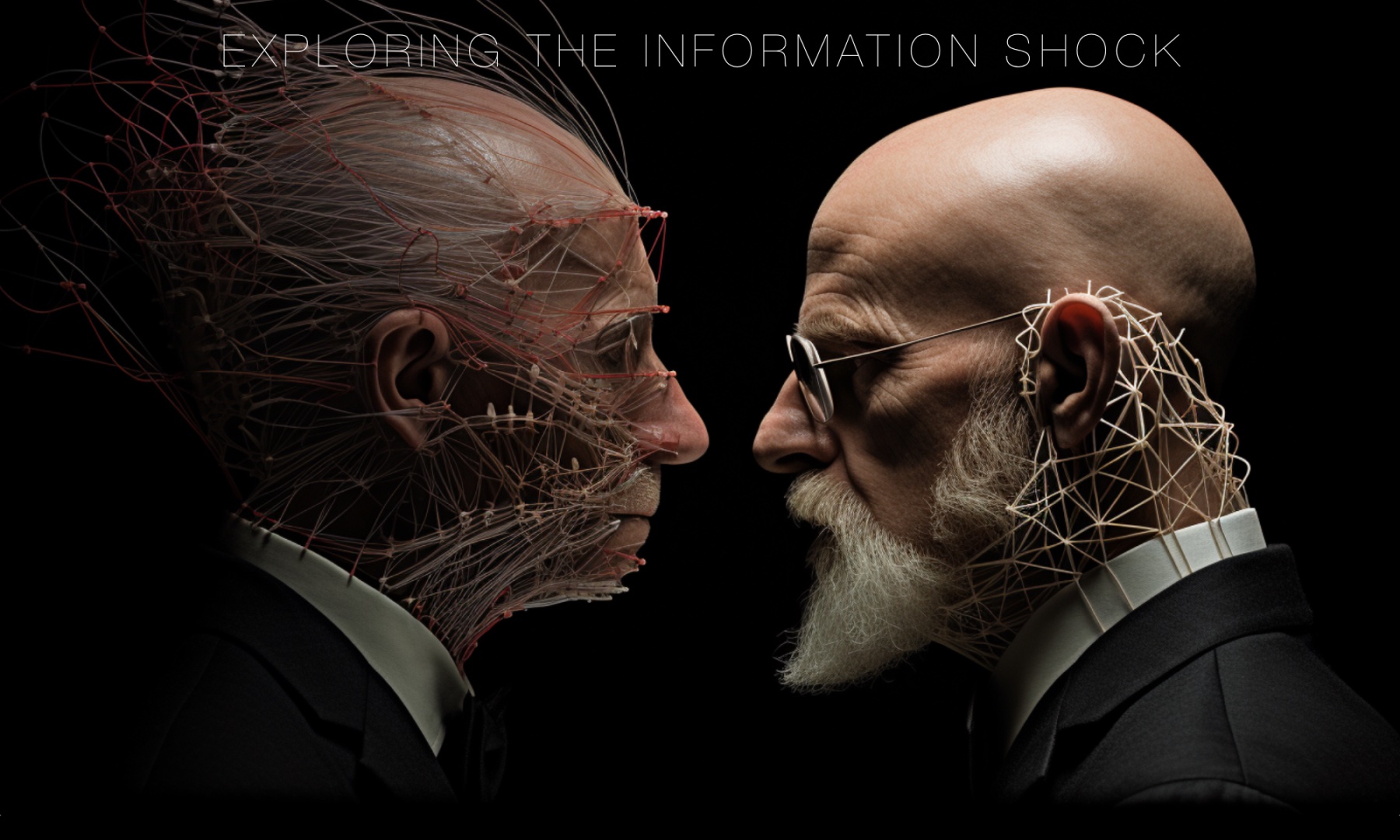
Lankes, R. D. (2026, July 3). Information Shock: How AI Demands an Evolution of Information Science. Retrieved from osf.io/preprints/socarxiv/36a97_v1
Beyond the Bullet Points: Bad Libraries
It happens from time to time. A quote of mine makes the rounds and then a somewhat predictable conversation occurs.
The quote is “Bad libraries build collections, good libraries build services, great libraries build communities.” This tends to lead to three reactions from librarians:
- 1. Yeah!
- 2. Collections aren’t bad
- 3. There’s no such thing as a bad library
This quote has been around for a long time, and I even came up with a standard reply 14 years ago: https://davidlankes.org/beyond-the-bullet-points-bad-libraries-build-collections-good-libraries-build-services-great-libraries-build-communities/
But, it happened again, and it went right to the “no such thing as a bad library.” I get it. Particularly in these times of attacks on libraries, the acknowledgement that they’re not all great seems like a guilty admission. But take it from an expert witness on a first amendment case against a public library, NOT acknowledging libraries can be bad is not just silly, it’s dangerous.
So, one more time for the folks in the back. There are no good or great libraries without bad libraries. An inability to admit that not every institution, even if formed to serve the greater good, is successful means you are complicit in lackluster service. Acknowledging that is how we get better, not blamed. There are bad doctors, there are bad fathers, there are bad apple pies. Your definition may be different than mine, but we have to at least begin with terms we agree to use.
If your school library has a dated and politically driven collection in a moldy room with no professional support – that’s a bad school library. If you want to say it’s no library at all, then fine. But then you are not saying there is a path to improve, simply a resignation to a horrible status quo. When the state of Texas took over Houston Independent School District and used the libraries as a place to sideline troubled youth, it was BAD. The fact that the students could still get books after hours didn’t redeem it. The fact that they called these daytime prisons libraries is BAD. Was this the fault of the school librarians? Absolutely not.
If your academic library sets aside 70% of its space for staff and does zero outreach to academic departments, that’s bad. If your public library is outsourced to a for-profit company to remove resistance to censorship: bad.
Admitting that libraries can be bad is why we support lawsuits against libraries to counter censorship. Admitting there are bad libraries is why we sue for open meetings, why we advocate for policies of transparency, why we fight for staff care.
And here is where I’ll lose some people: if you have built a library with the best of intentions but it doesn’t meet the needs of its community, that’s bad. If you see the role of your library as empowering people, but you refuse to collect controversial materials to avoid difficult conversations, that is bad.
And finally, yes, it is bad to treat the collection as paramount and ignore our first duty: helping our communities. Bad.
Libraries, Corrosive AI, and the Trust Paradox
Lankes, R. D., Gustina, M., & Lankes, R. D. (2026). Guest Editorial: Libraries, Corrosive AI, and the Trust Paradox. Public Library Quarterly, 1–8. https://doi.org/10.1080/01616846.2026.2644064
Table ronde virtuelle avec R. David Lankes
“Table ronde virtuelle avec R. David Lankes” Webinar. Fédération Des Milieux Documentaires
AI Free* Version of Triptych Now Available
TL;DR version: if you would rather read my latest book, Triptych, without the distraction of AI, then I have put out a new AI Free version. You can buy the new edition on Amazon. The content is the same, save for illustrations and AI generated discussion questions. New cover is from licensed stock art. The content is virtually identical in other ways (with a few edits made).

The first published version of Triptych used artificial intelligence to create images and a series of conversation starters used at the end of each lecture. As I stated in that version:
“I take my responsibility as an author and as a scholar seriously. That means having full ownership of the text and in writing from a place of experience… For me it [AI] is a tool and one I feel I need to use to better understand and write about. That said, I very much look to engage in a conversation about AI, the mission of librarians, and its impact in society.”
And a conversation was indeed had. Several reviewers and people I respect pointed out a key problem with including some AI-generated material in the book: it introduces a sort of fatigue when engaging the text. While a reader wants to be engaging the ideas, the even peripheral use of AI adds a sort of lingering doubt. Is what I am reading written by AI?
Continue reading “AI Free* Version of Triptych Now Available”Ice Storms, YouTube, and Private Equity
The title is more interesting than the post. This is just to let everyone know that I am taking advantage of being shut in at home during an ice storm to upload a bunch of my old presentation videos and the like to YouTube. I have been using Vimeo for over a decade, but they were recently purchased by a private equity firm that is laying off most of their staff. This does not inspire confidence for longterm prospects.
Of course Vimeo doesn’t make it easy to move everything to YouTube. So I’m doing my best to get a bulk of the videos transferred, but metadata and descriptions are a bit spotty. I’m really banking on auto-captions to do some of the heavy lifting.
Right now I’m not planning on redirecting the embedded videos in my blog nor take anything down from Vimeo. We’ll see what the future holds.
If you care (or want to see just how horrible my fashion and facial hair choices were in the past) keep an eye on my channel: https://www.youtube.com/@rdlankes
Triptych World Tour Goes to Scotland

Join us for a lecture by visiting Professor and Author R. David Lankes, exploring his recent book ‘Triptych: Death, AI and Librarianship’
Register here: https://www.eventbrite.co.uk/e/death-ai-and-librarianship-a-professor-r-david-lankes-lecture-tickets-1980451536859
Join CILIPS for a special event taking place in Edinburgh, delivered in partnership with the Scottish Library and Information Council (SLIC), where we are delighted to welcome Professor R. David Lankes for a one hour lecture in the National Library of Scotland, George IV Bridge. The lecture will begin at 11am and finish at 12pm, please ensure that you arrive promptly and take your seat before the lecture begins.
Continue reading “Triptych World Tour Goes to Scotland”I’m in love with Brazil
Last week I had the absolute honor of presenting in Sao Paulo Brazil I spoke at FESPSP 85th anniversary of their library science program and at the 23º Seminário Nacional de Bibliotecas Universitárias (23rd National Seminar of University Libraries). I met so many dedicated and innovative librarians working to make Brazil better through librarianship. The programs, scholarship, and initiatives were world-class. The students brilliant. On a personal note, I cannot tell you how meaningful it is to see one’s work being put into action and having a real impact.
I would like to thank everyone I had a chance to meet and learn from. Special thanks to Jorge Prado, Adriana Ferrari, and Adriana Souza.
Death, AI, and Librarianship
“Death, AI, and Librarianship” Plenary. 23º Seminário Nacional de Bibliotecas Universitárias. Sao Paulo, Brazil.
Abstract: Em uma era marcada pelo isolamento social, desinformação e crescente desesperança, bibliotecários de todos os tipos devem evoluir de prestadores de serviço passivos para agentes ativos de resiliência comunitária e infraestrutura que salva vidas. Esta palestra desafia as definições tradicionais da Biblioteconomia, defendendo um modelo mais inclusivo e adaptável, que valorize missão, valores e engajamento comunitário acima de credenciais formais. Ao abraçar a alegria, o uso ético da IA e as narrativas locais, os bibliotecários podem fomentar a confiança, empoderar comunidades e liderar mudanças transformadoras em um mundo fragmentado.
A New World Tour?

Back in 2015 I had an Expect More World Tour. I was fortunate to be invited to talk about New Librarianship in countries like the UK, New Zealand, Canada, Italy, and the Netherlands.
Well, new book, new opportunities. I’m off to Brazil next week and things are in the works for the UK and Europe in the Spring. As always I’ll post materials from the visits, and let me know if you have an opportunity to go abroad and say hi.